Talk · data2day 2026
Agentic Analytics: From Hype to Real Value
Fabian Biberger (Founding Engineer, Entropy Data) ·
Fabian Biberger’s talk at data2day 2026 in Cologne, held in German as Agentic Analytics: Wie aus Hype echter Mehrwert wird. It follows Entropy Data’s path from an MCP server to a governed chatbot, the context an agent needs to work reliably on data, and Apache Ossie for ontologies and semantic models.
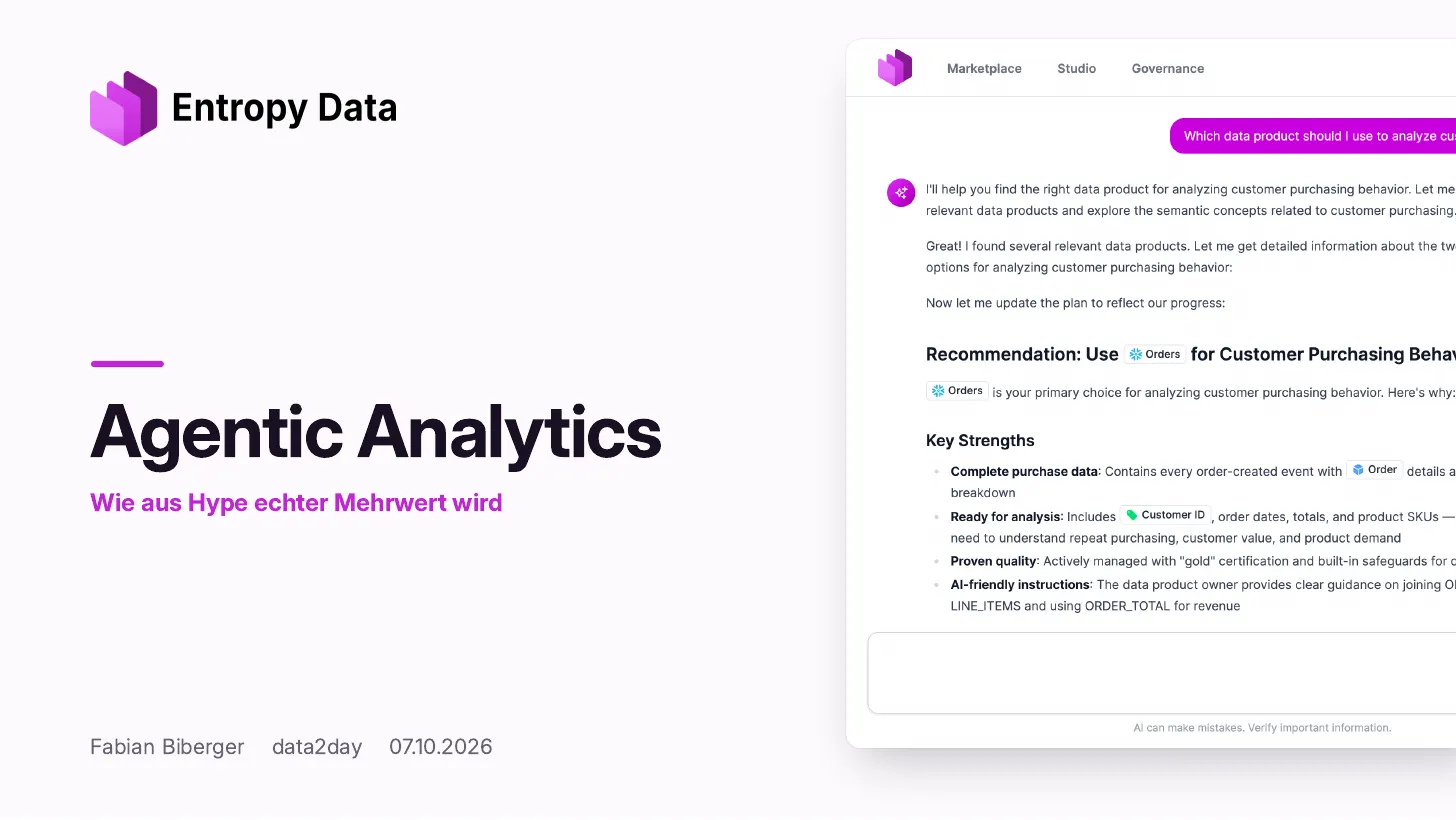
An edited summary of the talk, translated from German.
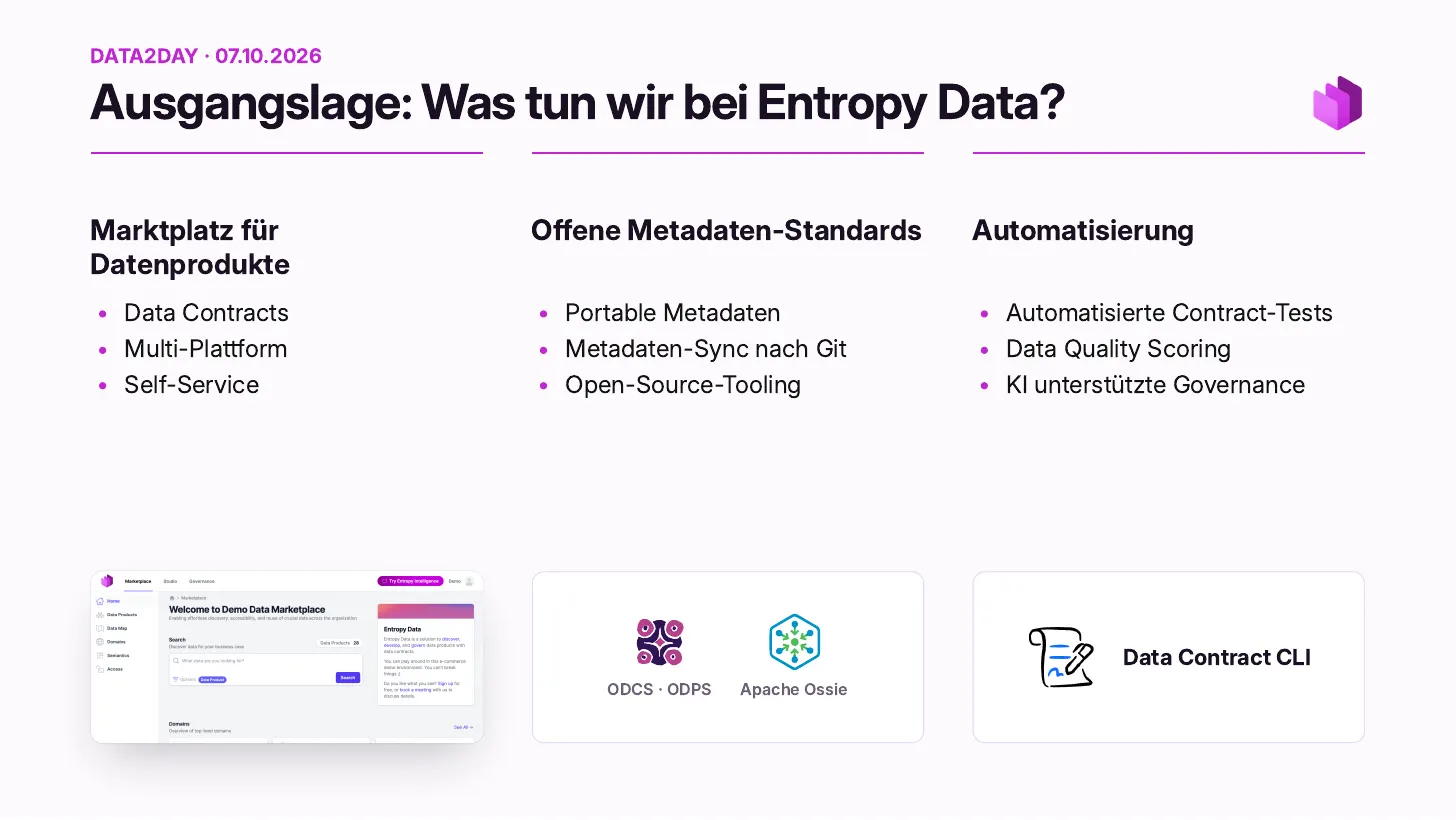
Where Entropy Data Starts From
- Marketplace for data products with data contracts, multi-platform, and self-service.
- Open standards: ODCS, ODPS, and Apache Ossie.
- Automation: contract tests with the Data Contract CLI, data quality scoring, AI-assisted governance.
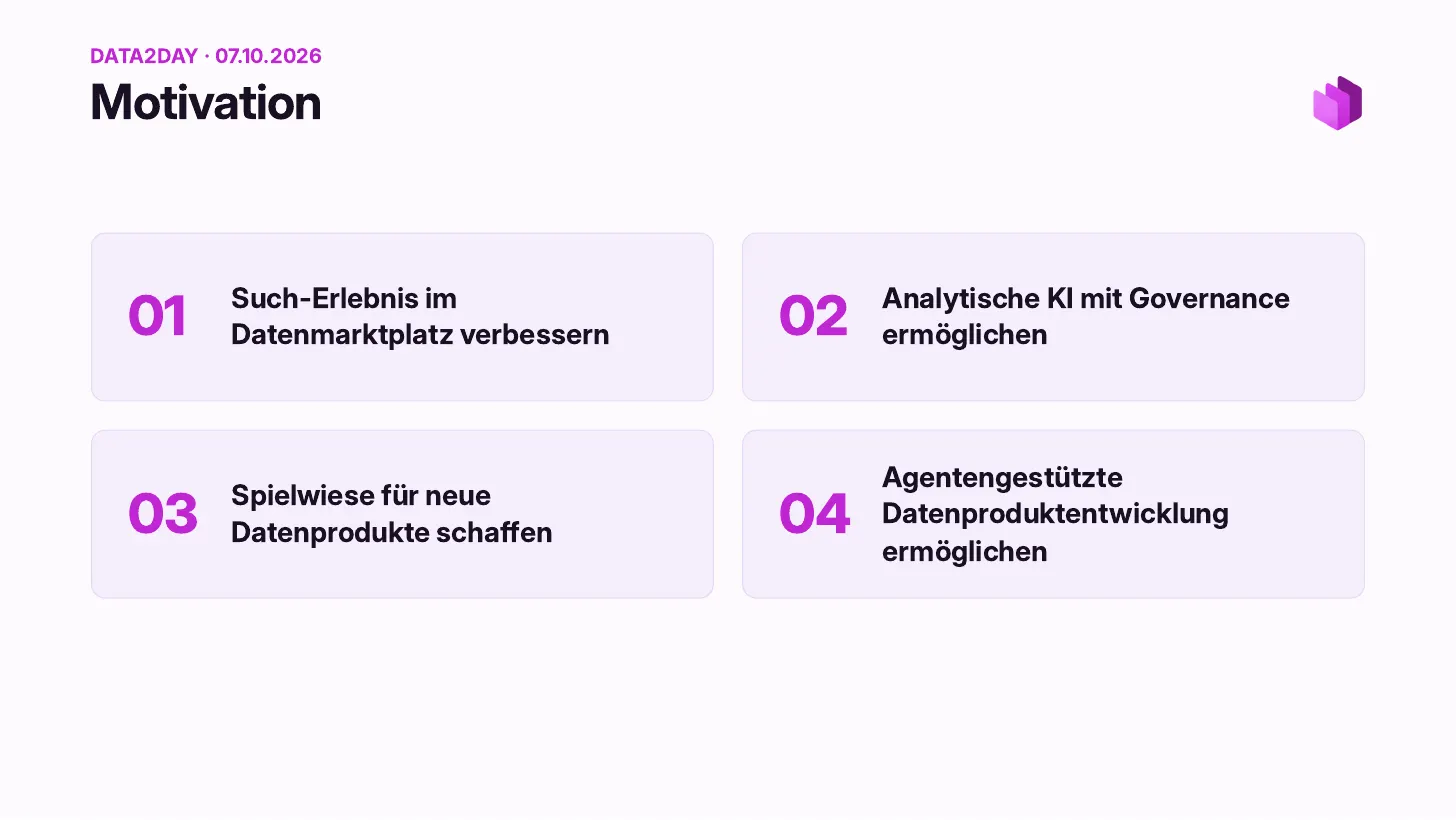
Four Reasons to Go Agentic
- Better search in the data marketplace.
- Analytical AI with governance.
- A playground for new data products.
- Agent-supported data product development.
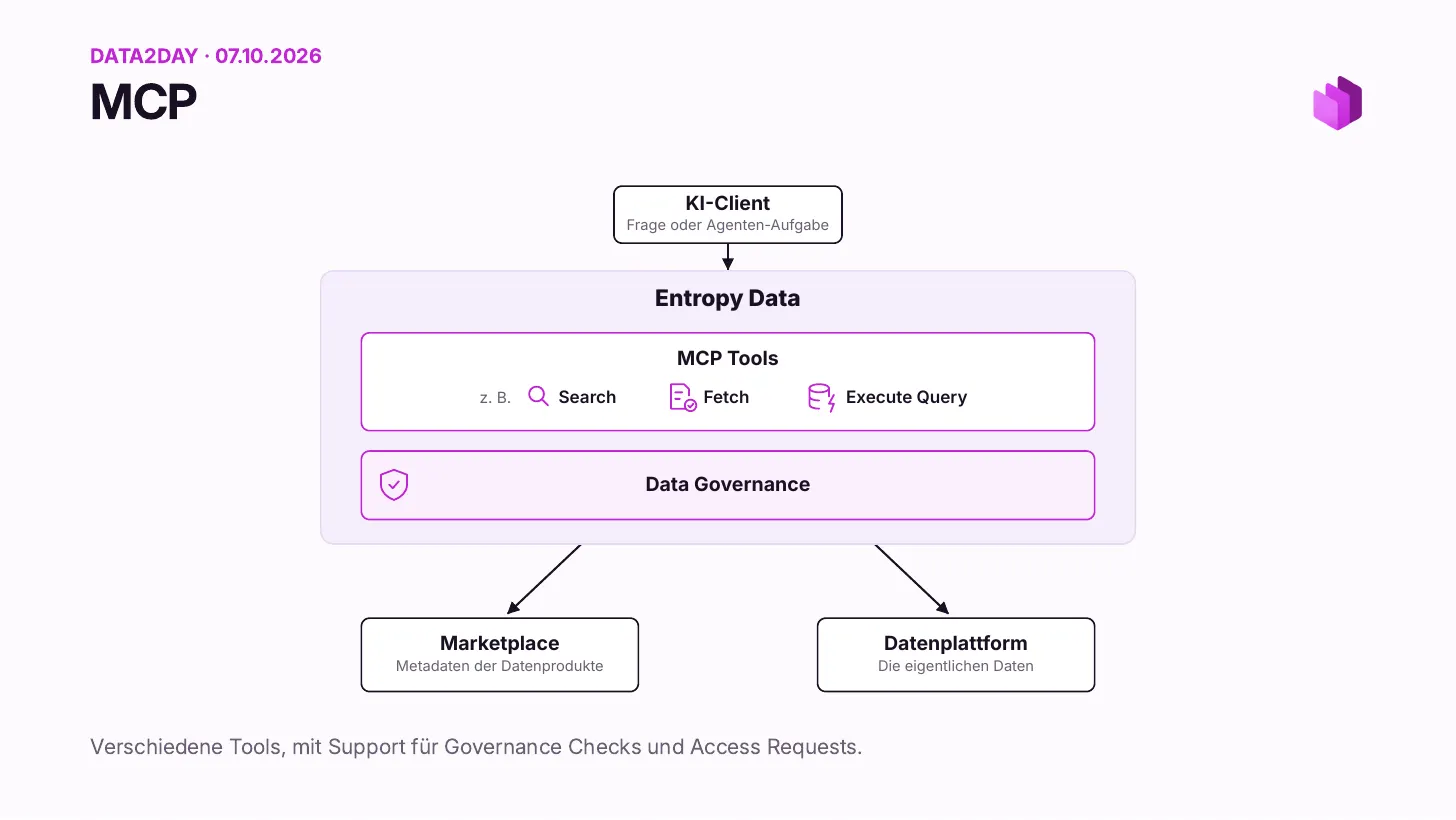
Step One: An MCP Server
- AI clients such as Claude or ChatGPT connect to the marketplace via MCP.
- Tools: search data products, fetch data contracts, execute queries.
- Governance checks and access requests sit in between.
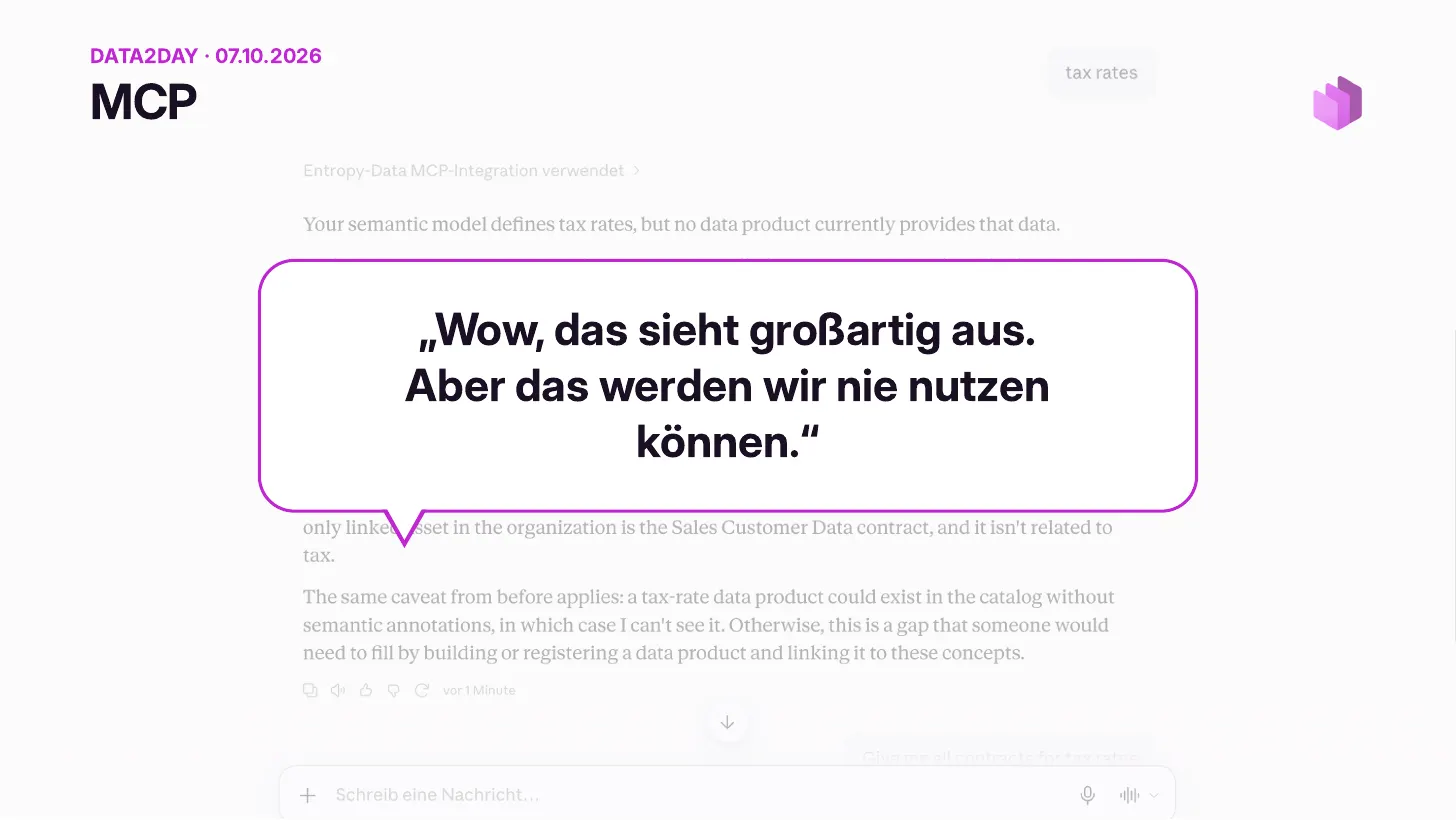
“Wow, That Looks Great. But We’ll Never Be Able to Use It.”
- Governance: MCP combines data on a personal computer, outside governance.
- Availability: many companies have no approved chat client, or only Copilot.
- Decision: build our own chatbot.
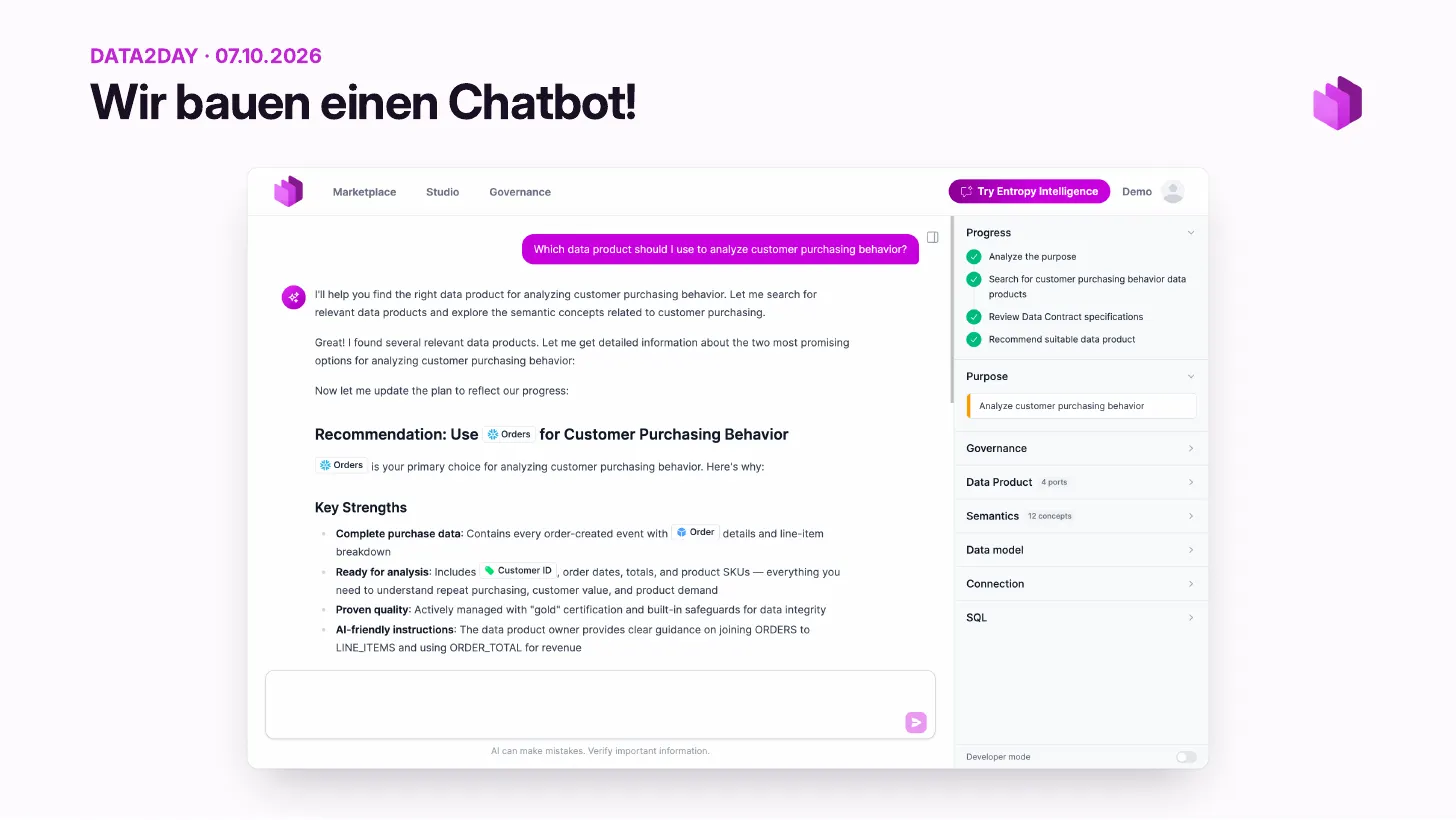
So We Built a Chatbot
- Entropy Intelligence lives inside the marketplace, under existing governance.
- The system prompt can be adjusted to Entropy Data's use cases.
- MCP tools are built in directly, and governance cannot be bypassed.
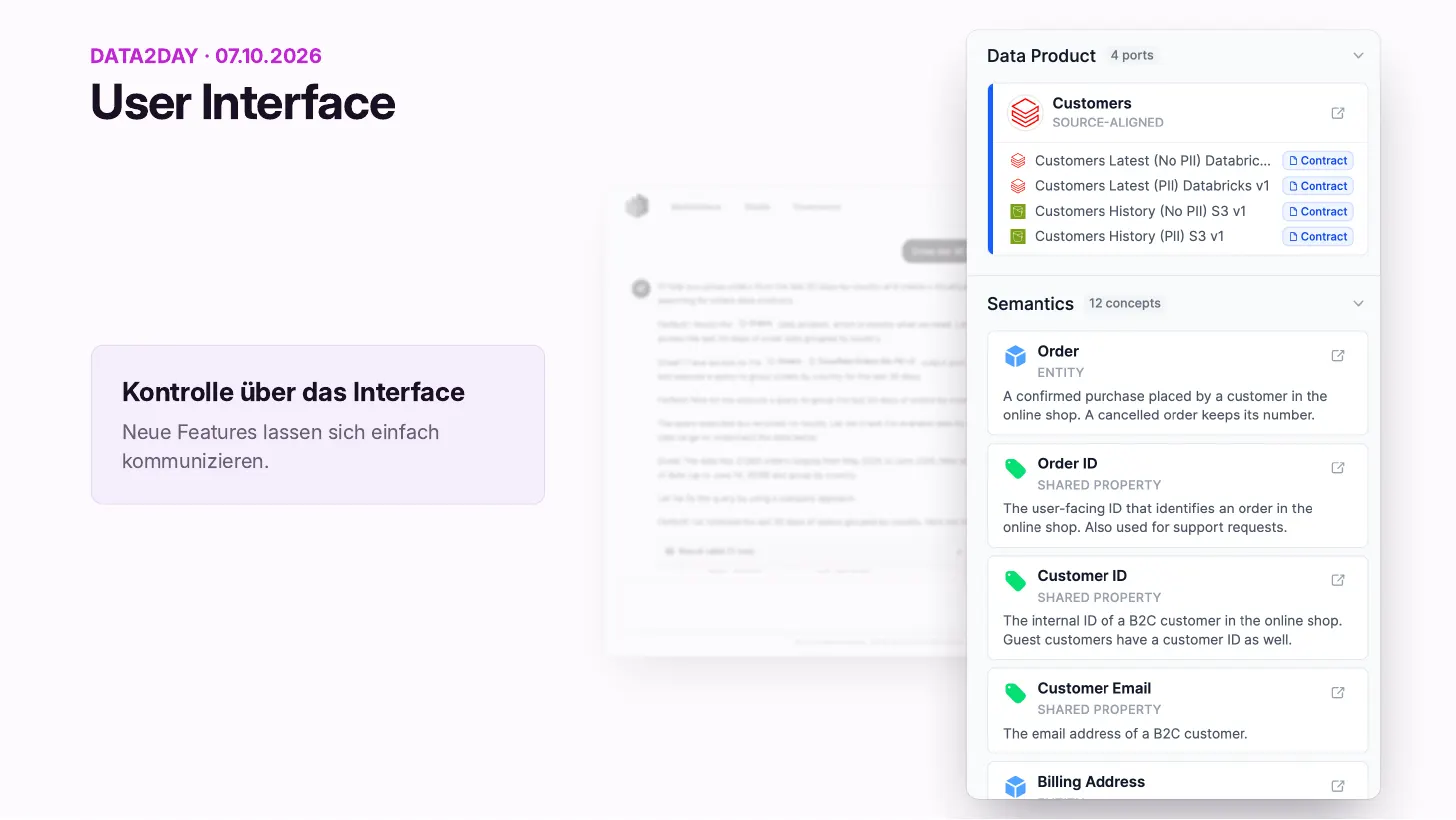
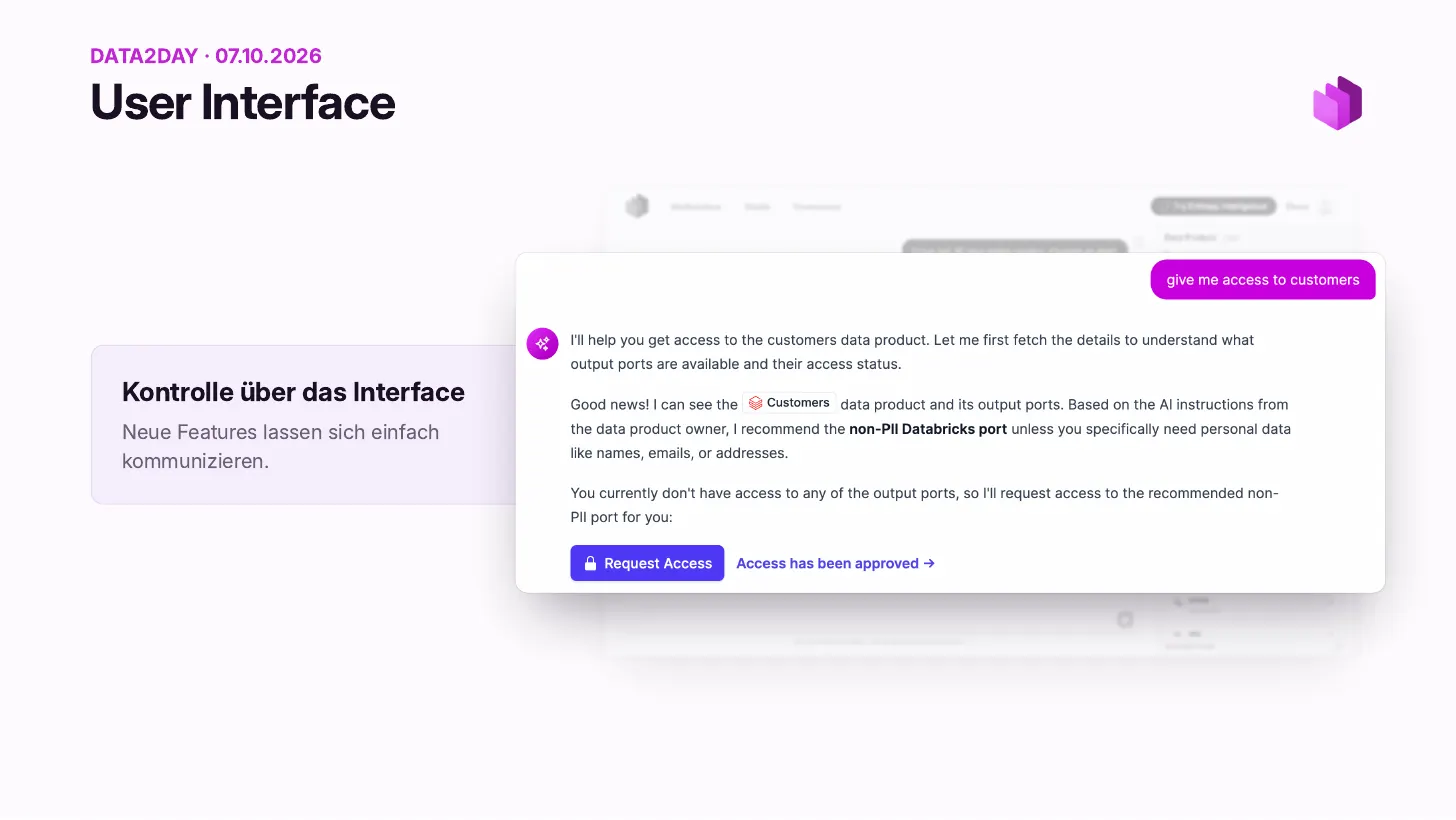
"Neue Features lassen sich einfach kommunizieren": with control over the interface, new features are easy to communicate.
User Interface
- Better traceability through the context sidebar: data product, output ports, semantic concepts, and purpose at a glance.
- New features directly integrated, for example a Request Access button right in the conversation.
- Reused interface elements, such as the chips and icons from the marketplace, help users find their way.
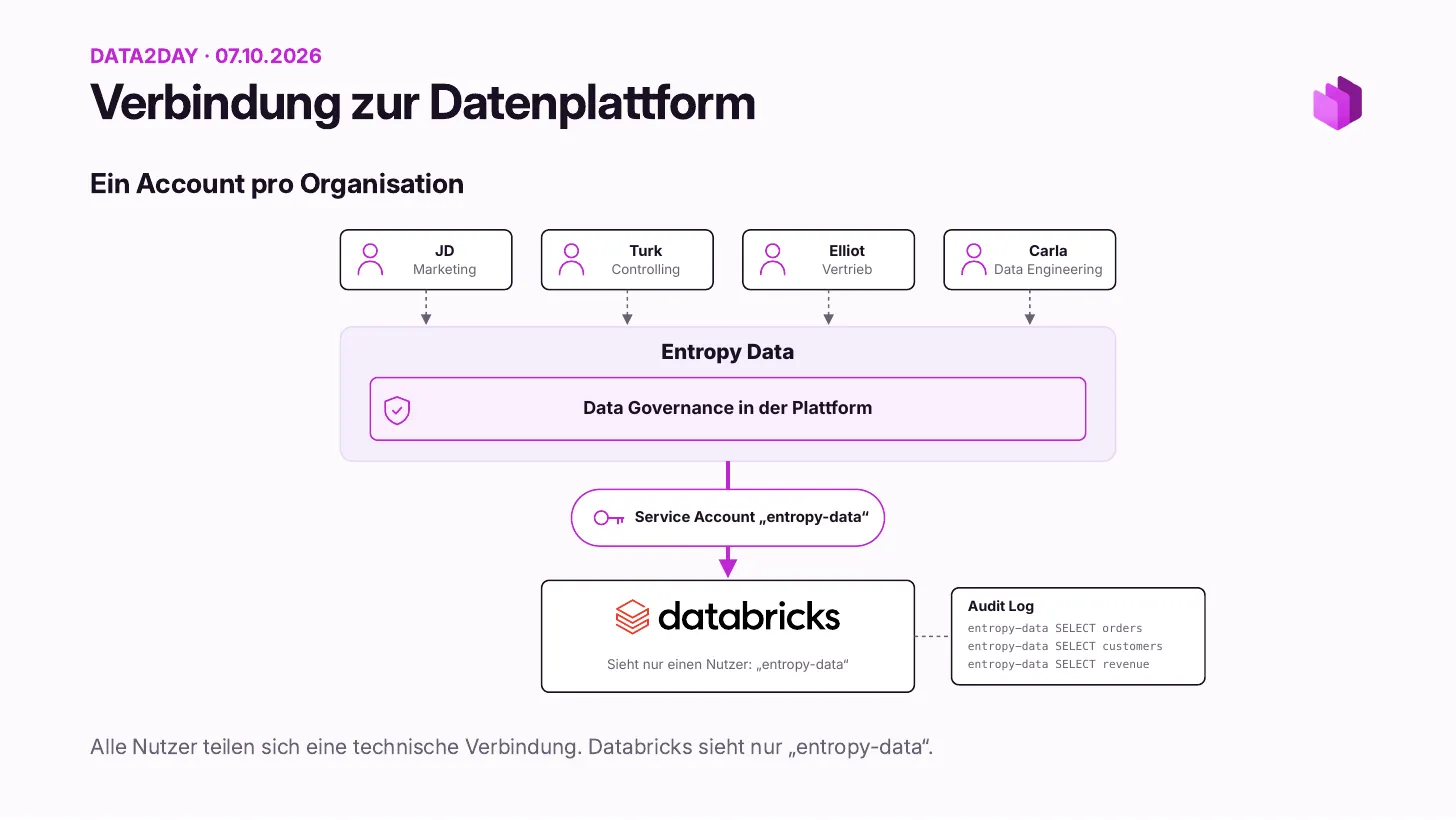
Who Is Actually Querying the Data?
- One service account for the whole organization.
- Databricks only sees one user:
entropy-data. - The audit log no longer shows who accessed what.
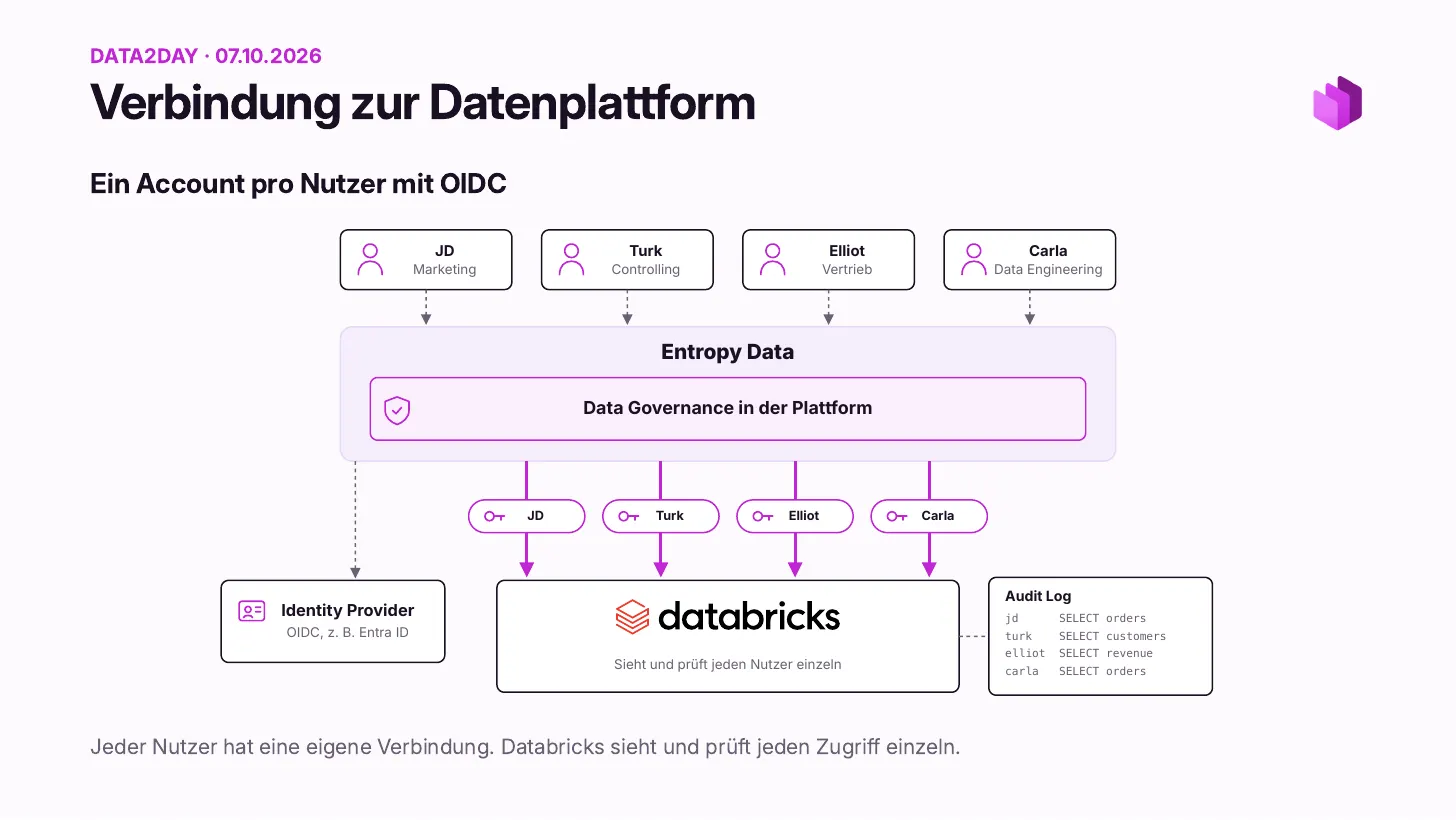
- OIDC: the identity provider, for example Entra ID, passes each identity to the platform.
- Databricks checks every access individually, and the audit log is meaningful again.
- Principle: first decide whose identity data access runs under.
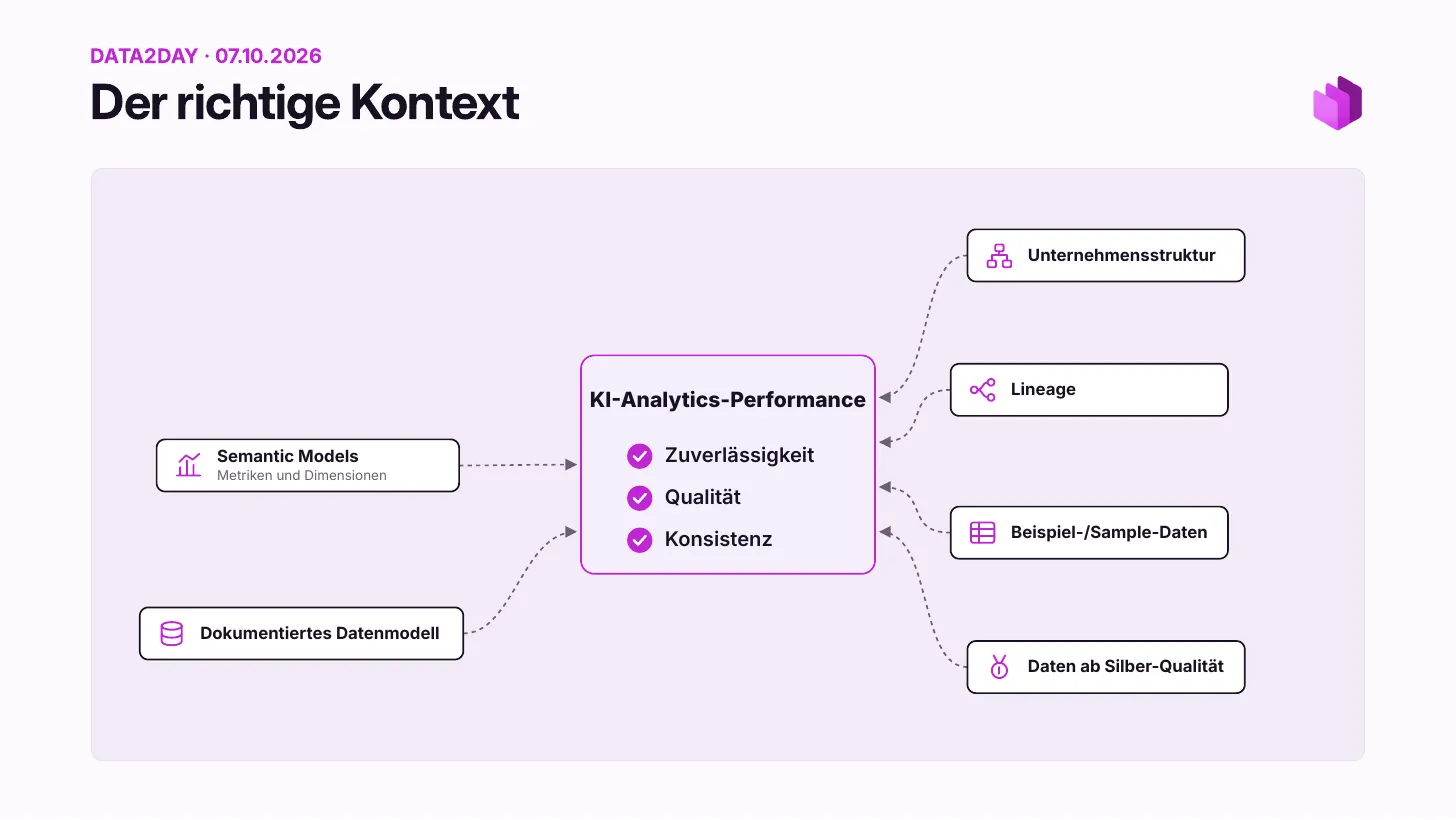
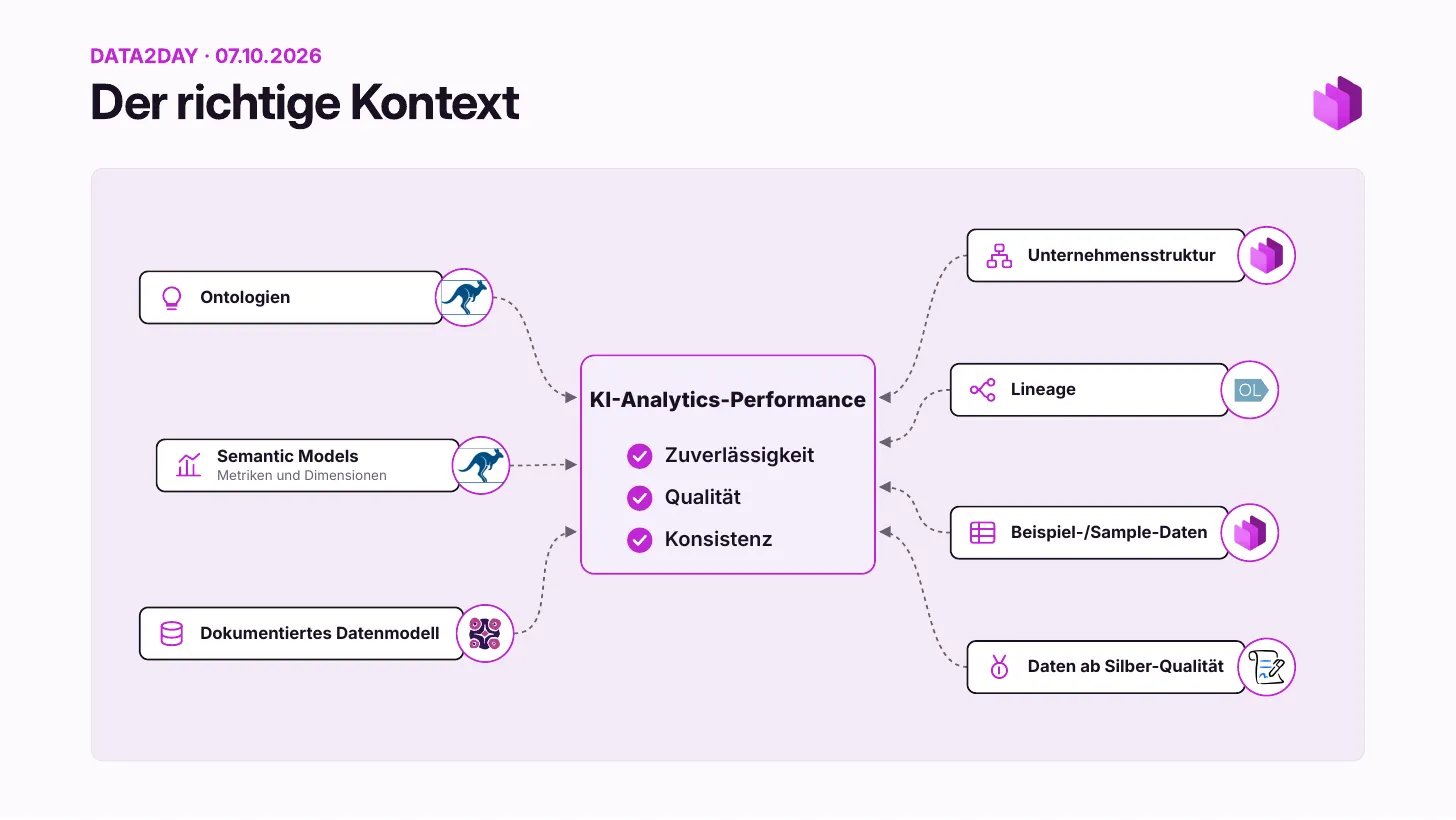
The Right Context: Seven Factors
- Basics: data of at least silver quality and a documented data model.
- Boosts: company structure, lineage, and sample data.
- Semantics: semantic models (metrics, dimensions) and ontologies (shared concepts).
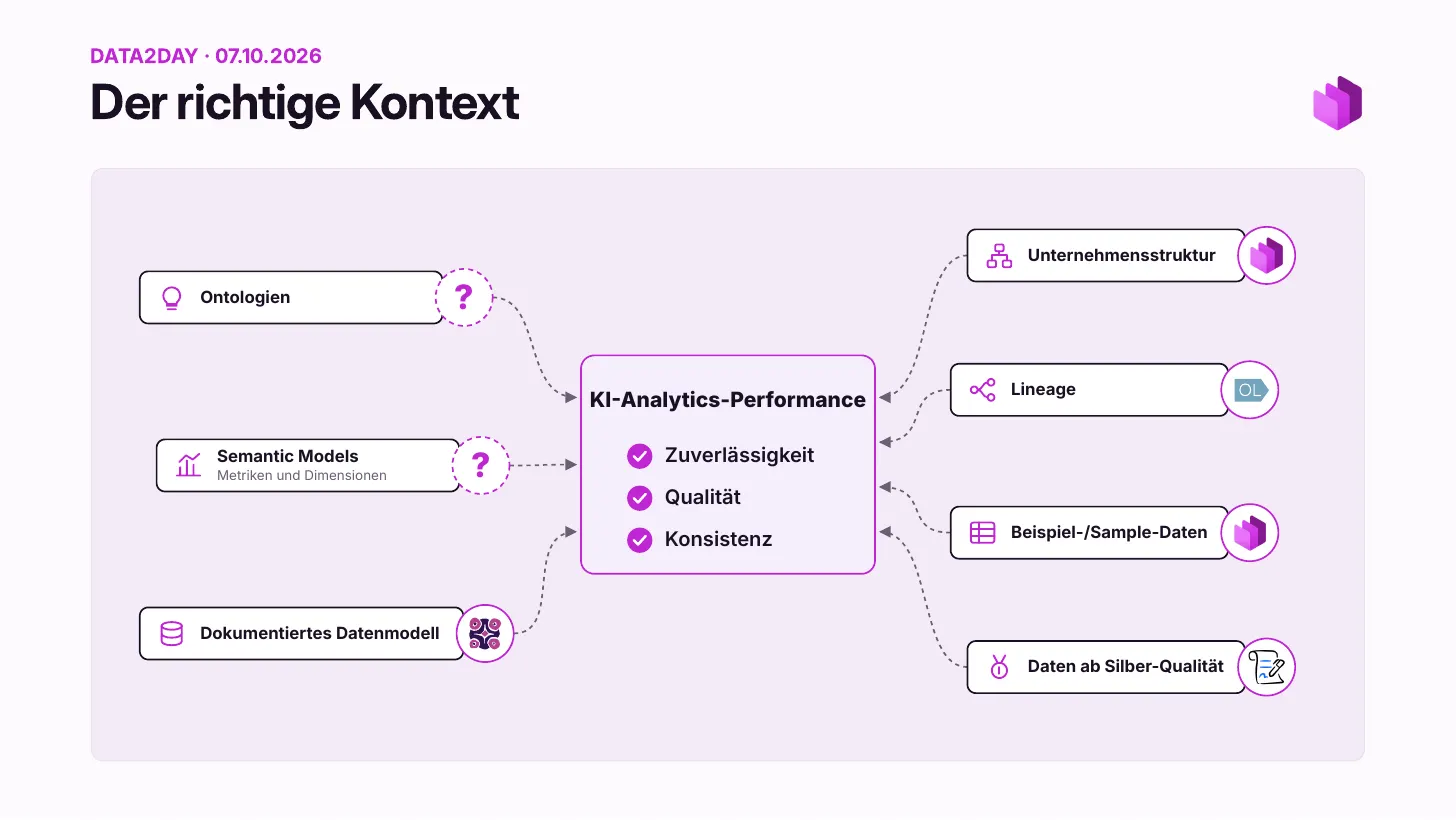
Five Covered, Two Open
- Data model and silver quality: covered by data contracts and contract tests.
- Lineage through data product links and OpenLineage, sample data stored partly in the data contracts, company structure as teams and domains.
- Still open: semantic models and ontologies.
Apache Ossie
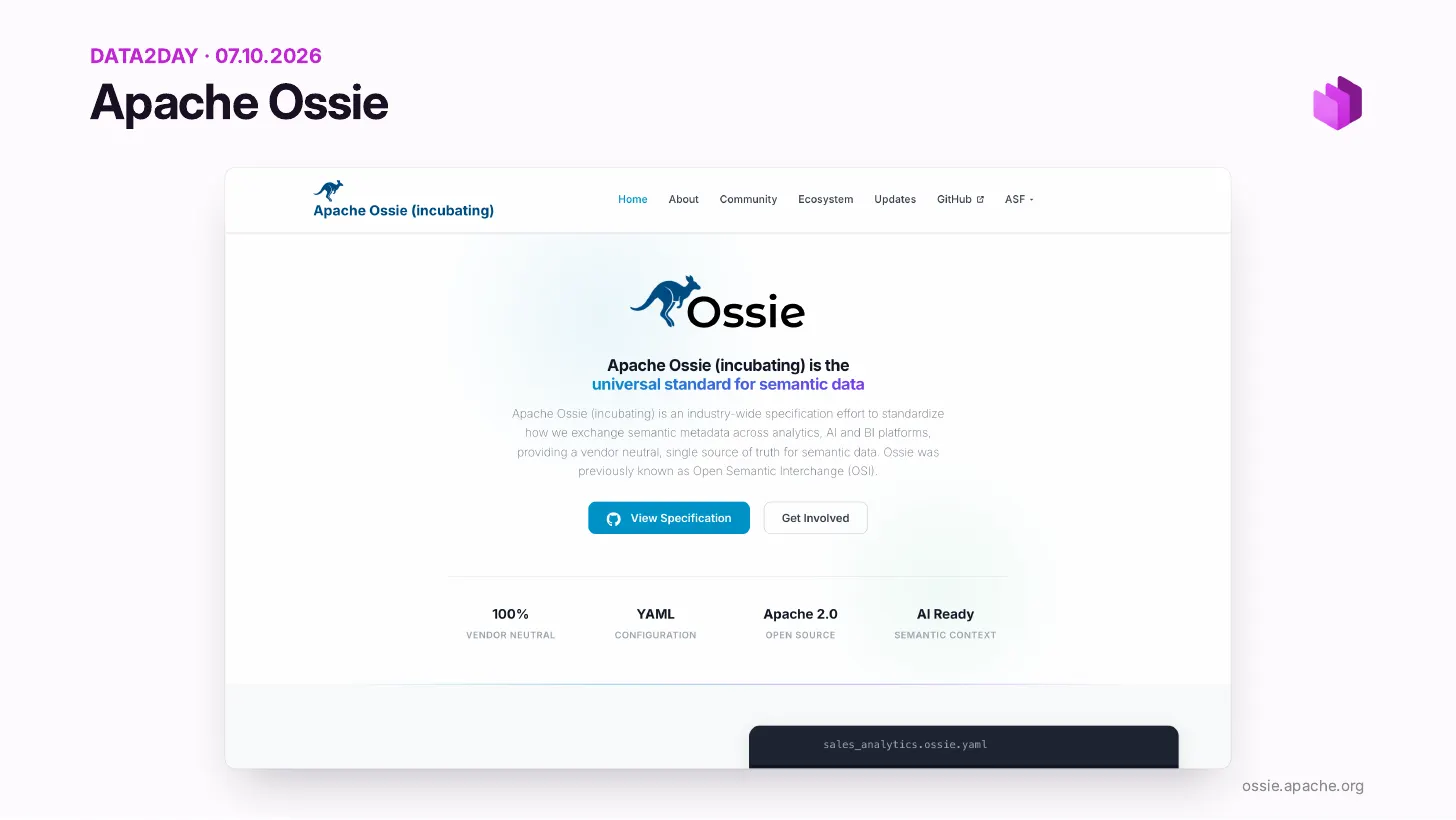
- Formerly Open Semantic Interchange (OSI), now Apache Ossie.
- An incubating Apache project for semantic models and ontologies.
- Entropy Data supports it as its format for semantics.
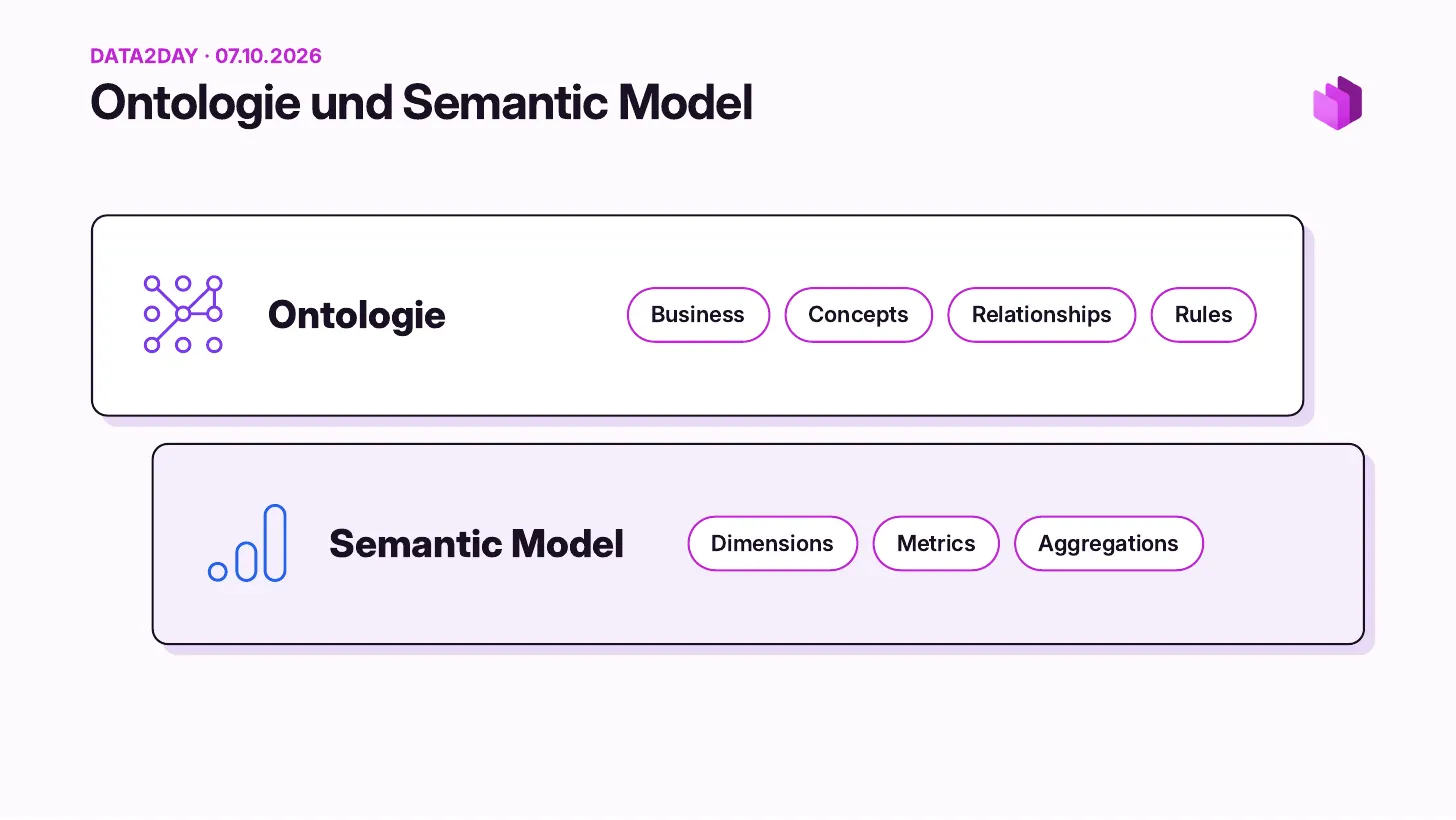
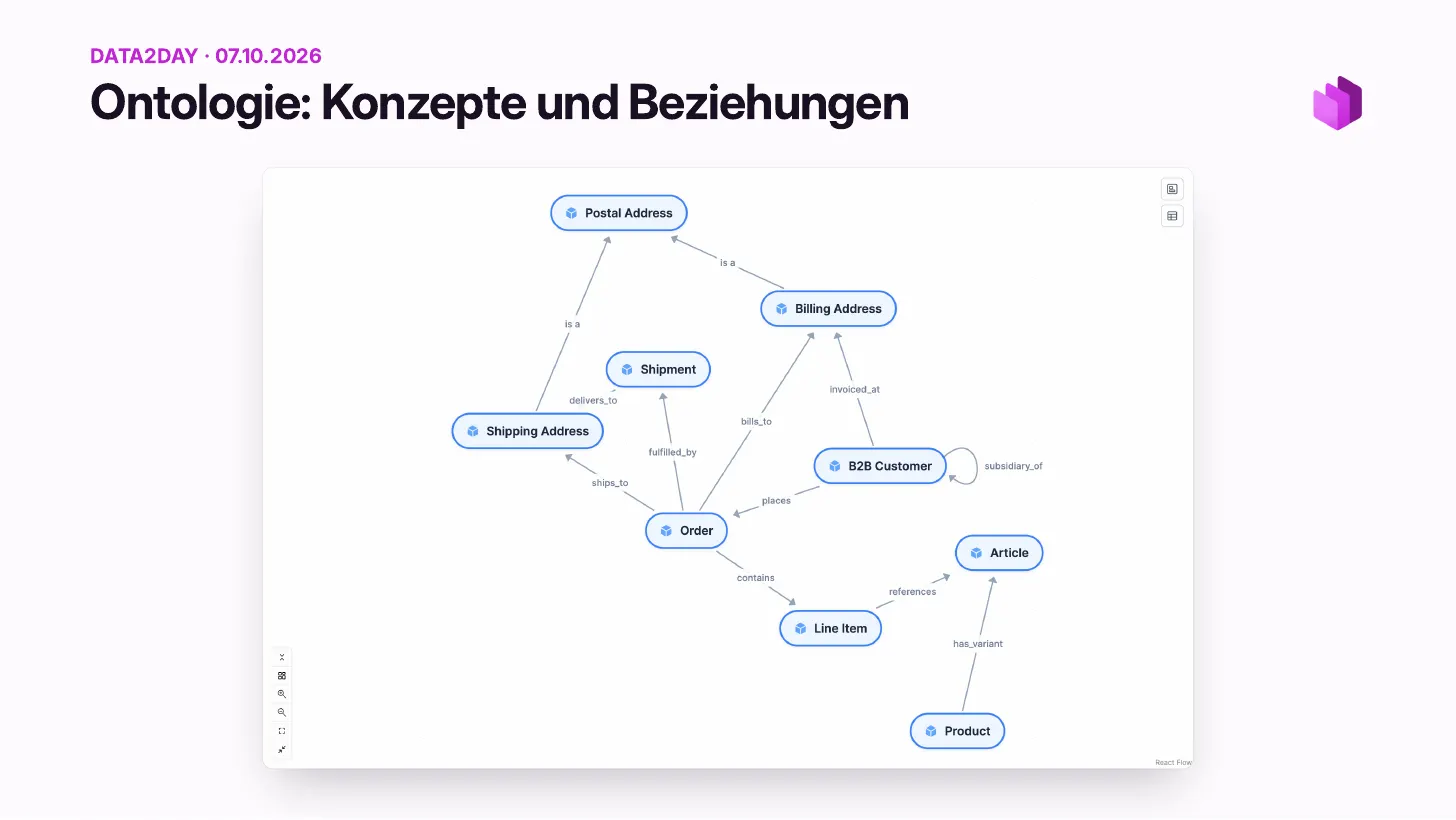
Ontology and Semantic Model
- Ontology: concepts such as Order, with properties.
- Relationships carry meaning: an order ships to a shipping address.
- More meaning gives the agent more context.
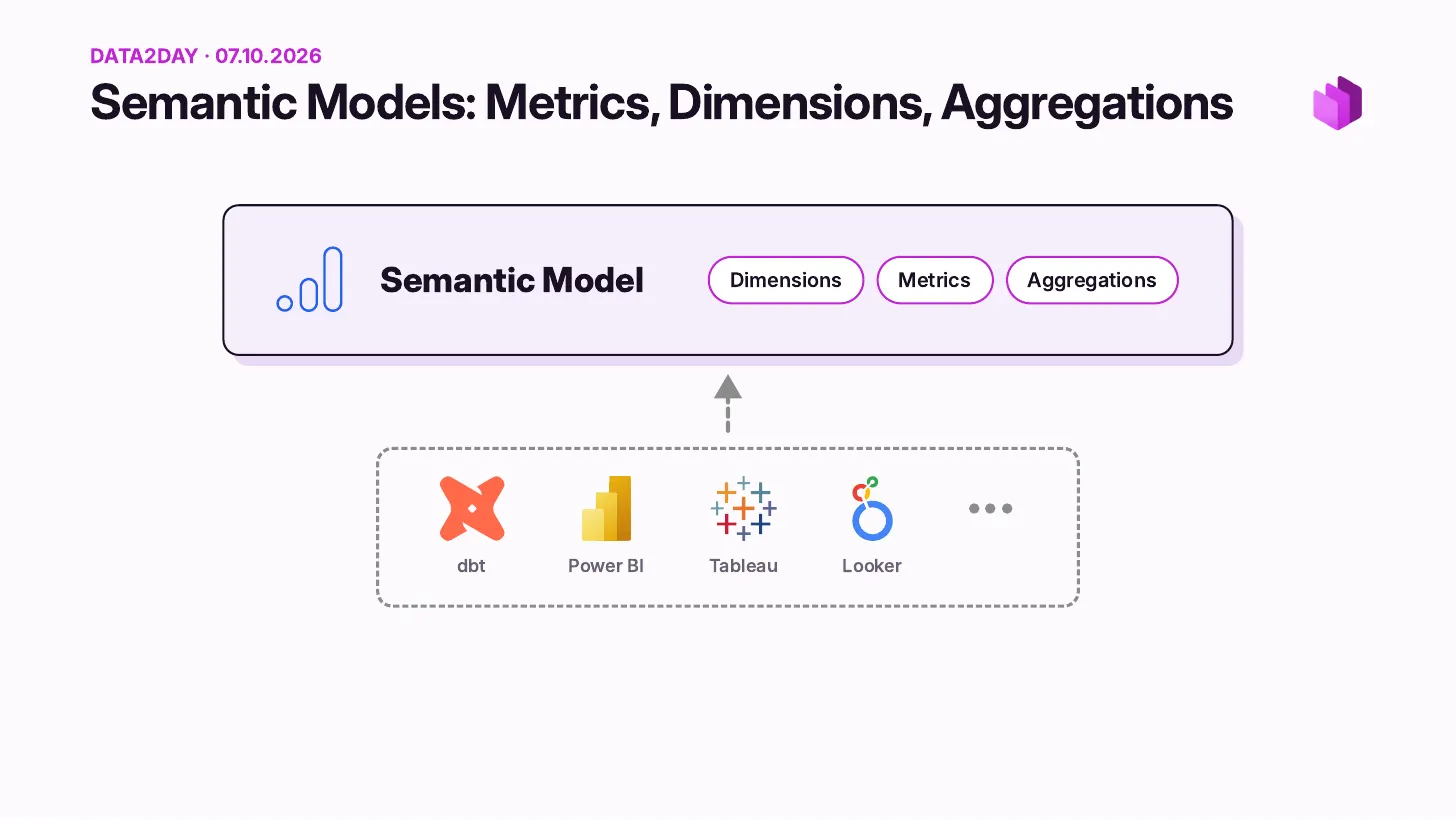
- Semantic model: metrics, dimensions, and aggregations over the data.
- Known from dbt MetricFlow, Power BI, Tableau, and Looker.
- Calculation logic, such as the order value, is defined in one place.
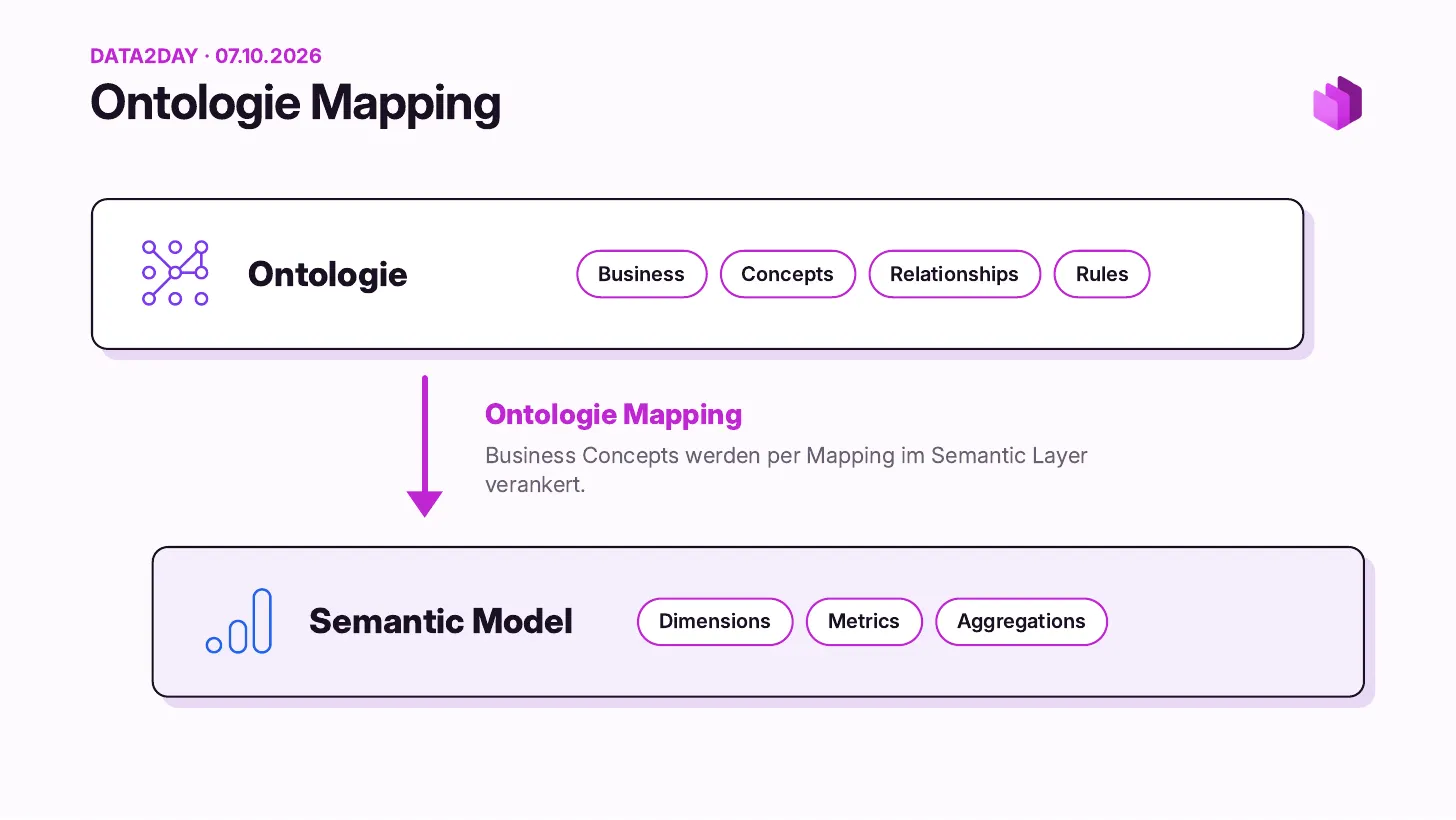
- Ossie anchors the ontology in the semantic models.
- A mapping layer links each concept to where it appears.
- With that link, the agent builds better queries.
Where to Start
- Start with the basics: a documented data model and silver-quality data.
- Company structure, lineage, and sample data are boosts on top.
- Semantic models and ontologies add better results and traceability.
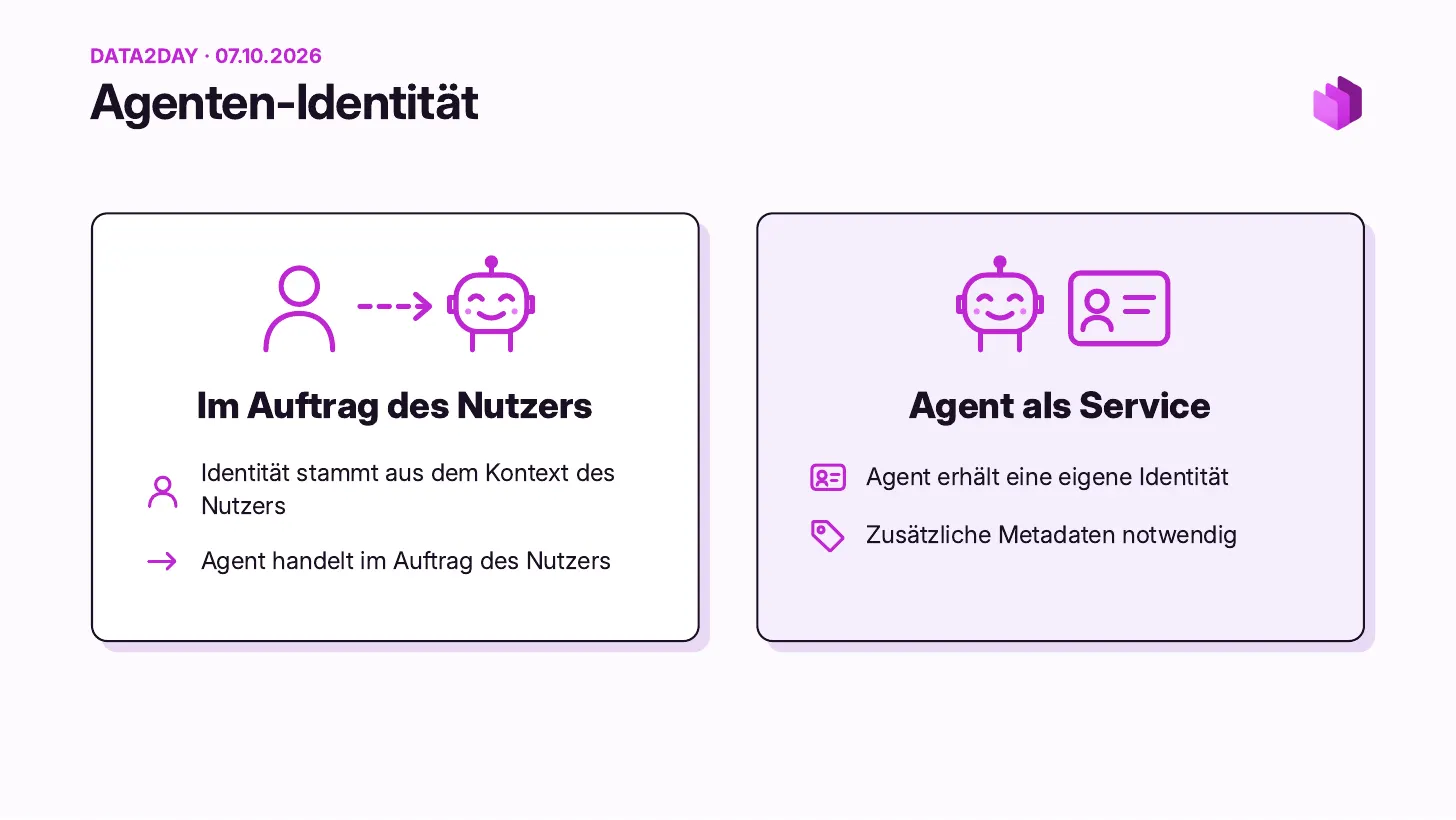
The Agents Are Coming
- Autonomous agents need an identity too.
- On behalf of the user: the identity comes from the user, as in the chatbot today.
- Agent as a service: an own identity, plus metadata such as the operator.
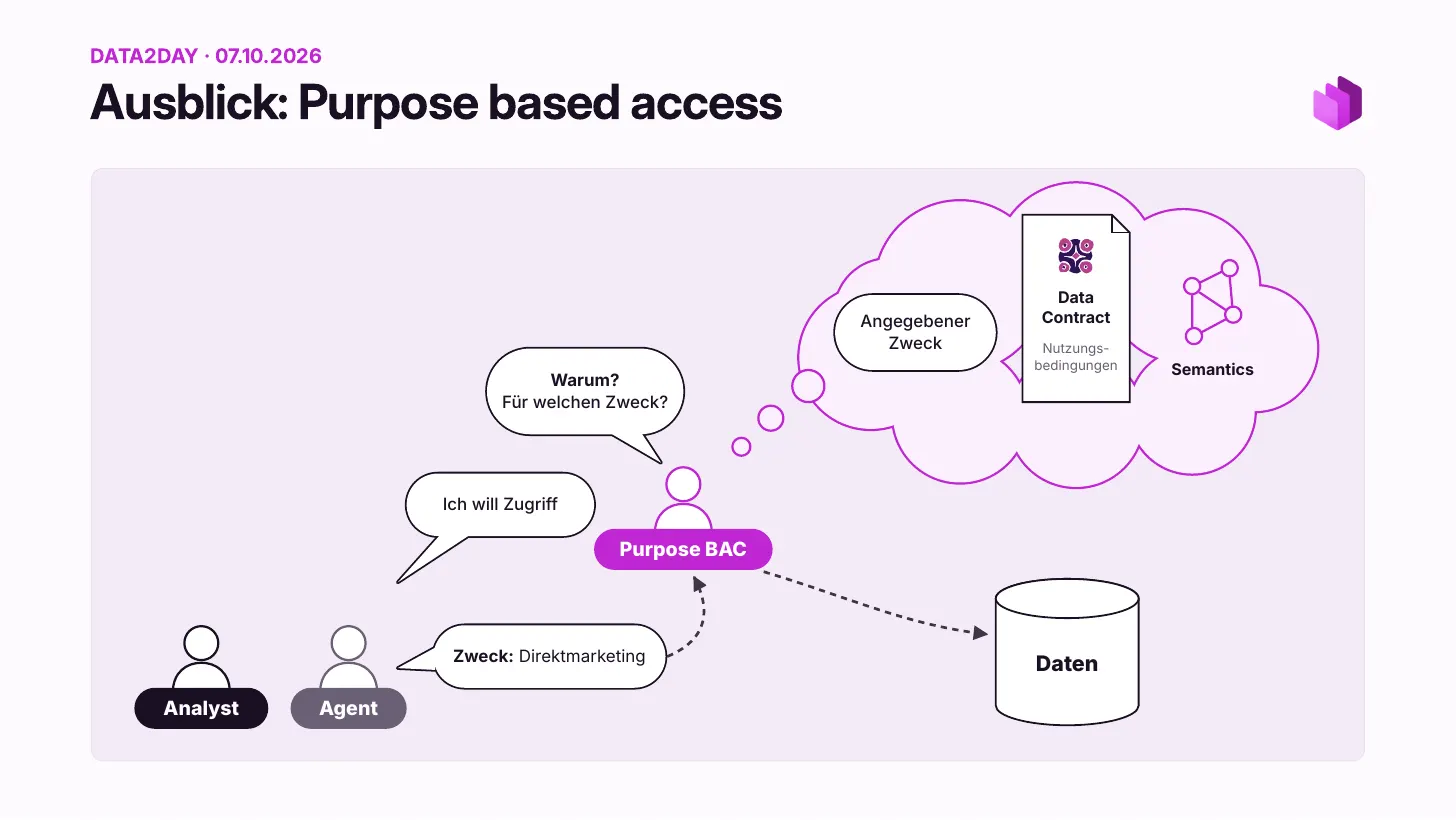
Outlook: Purpose-Based Access
- Analysts and agents must state why they need the data.
- The purpose is checked against the terms of use in the data contract and the semantics.
- An idea from the Q&A: limit access in time, for example to the agent's session.
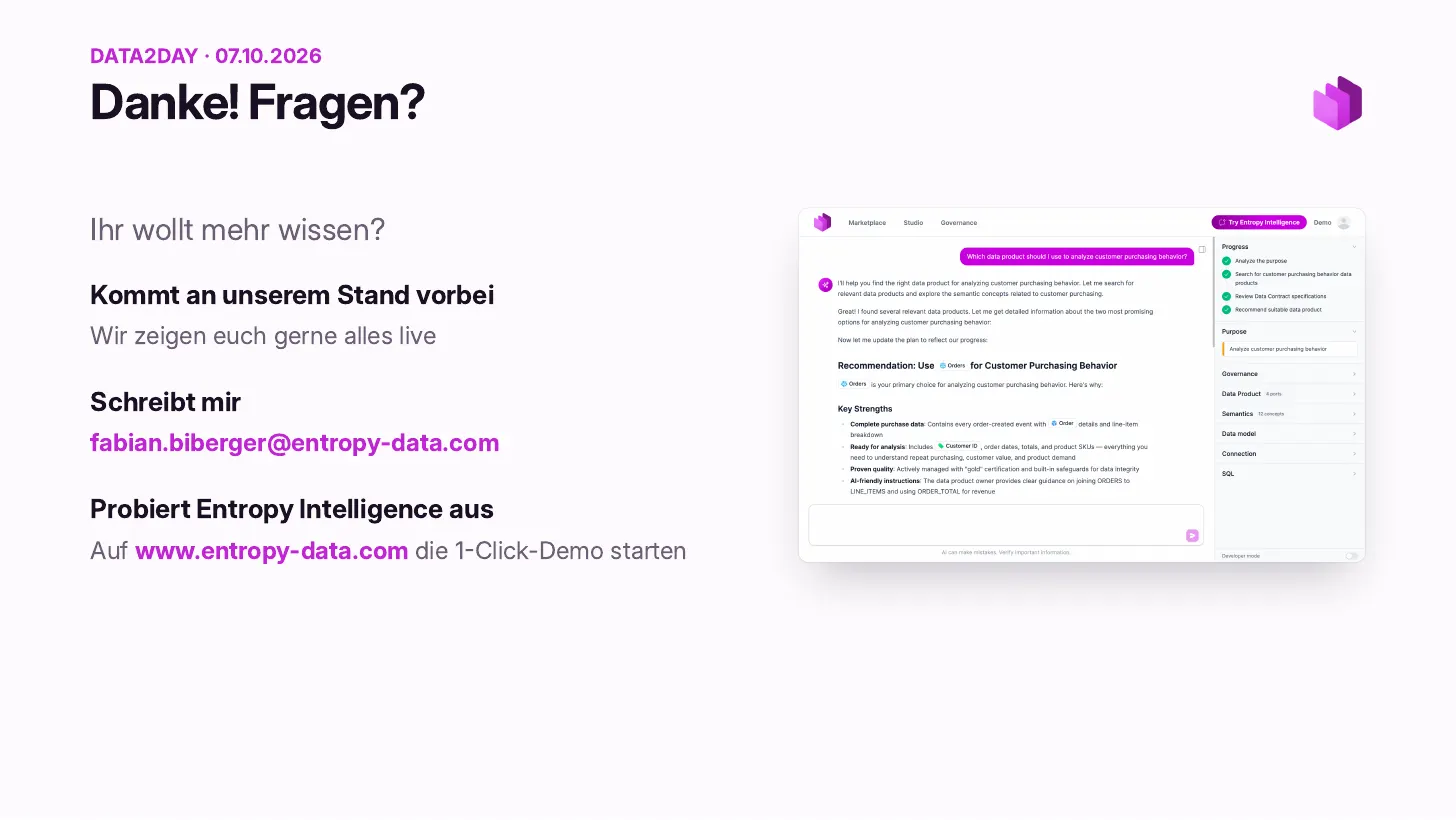
Try It Yourself
- Start the 1-click demo at demo.entropy-data.com.
- Read about Apache Ossie and MCP.
- Test your data contracts with the Data Contract CLI.
Related articles
A Data Marketplace is What Your Agent Needs
Why AI agents need a data marketplace to read data through governed tools and to build new data products, with two live demos.
What is Apache Ossie?
The open standard for ontologies and semantic models, formerly known as Open Semantic Interchange.
What is Purpose-based Access Control?
AI agents decide at runtime which data they need. Purpose-based access control checks every query against the terms of use in the data contract.