Feature
Semantics: Connect Business with Data Products

Jochen Christ
Co-Founder & CTO, Entropy Data ·
A schema tells you how data is stored. A semantic layer tells you what it means. This page explains what a semantic layer is, how Entropy Data's Semantics feature models one, and how the resulting ontology connects to data products and data contracts.
The problem
Most data platforms do a good job of telling you which table, which column, and which type. They do a worse job at telling you what any of it means. The questions that slow teams down tend to be of the second kind:
- Three teams have a
customer_idcolumn. Do they refer to the same customers? Are guest checkouts included? - Finance and Product both report Gross Merchandise Value. The numbers do not match. Which formula is authoritative?
- A new analyst needs shipment tracking data. Searching for "shipment" across a dozen schemas returns forty columns. Which ones are canonical?
These are semantic problems, not schema problems, and they scale poorly as the number of data products, teams, and AI tools grows.
What a semantic layer is
A semantic layer is a named, governed definition of your domain, independent of any specific table or system. It is built from two main elements:
- Concepts: the things in your business: entities, properties, and metrics.
- Relationships: how those concepts connect to each other and to data contract fields.
Concepts
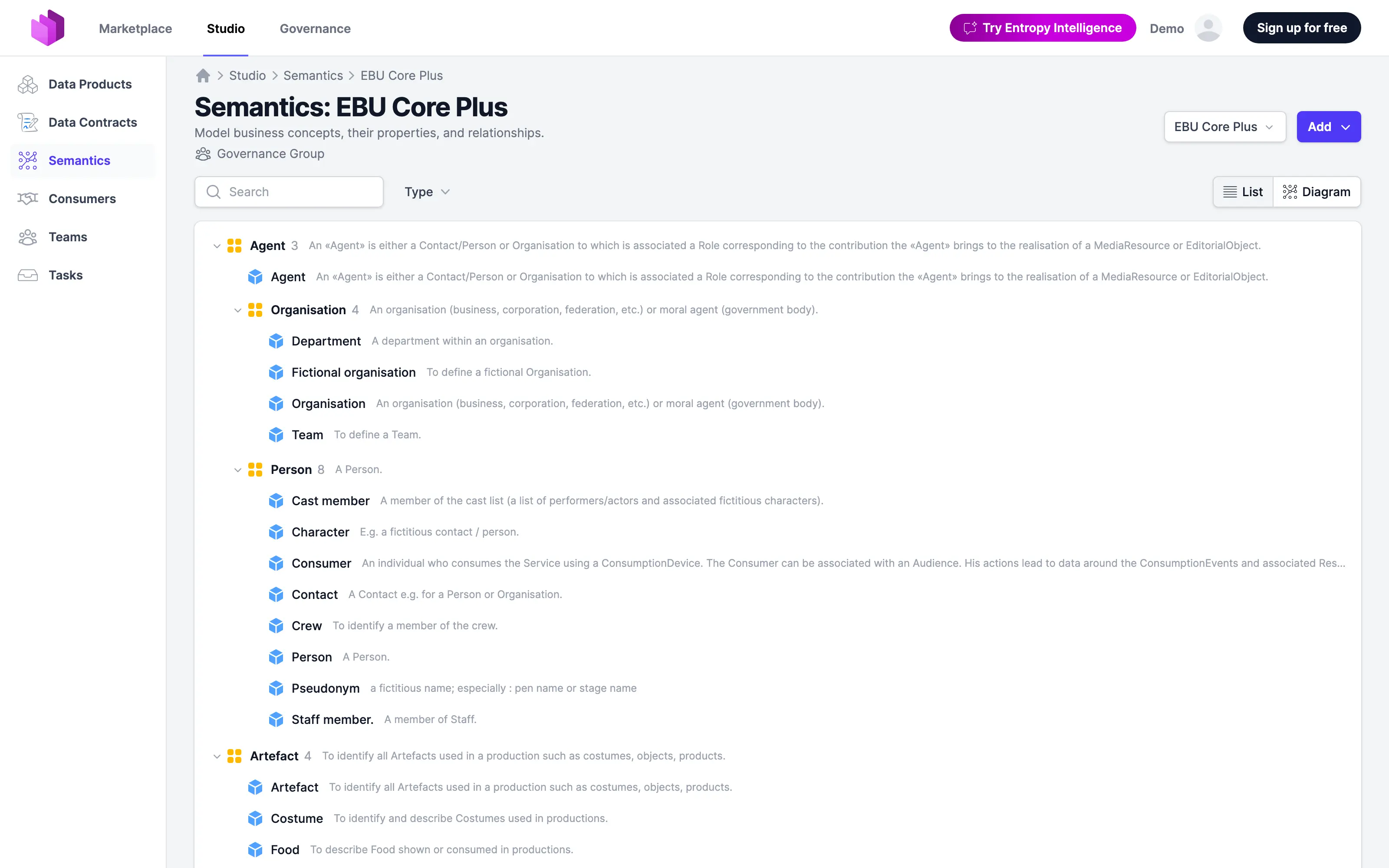
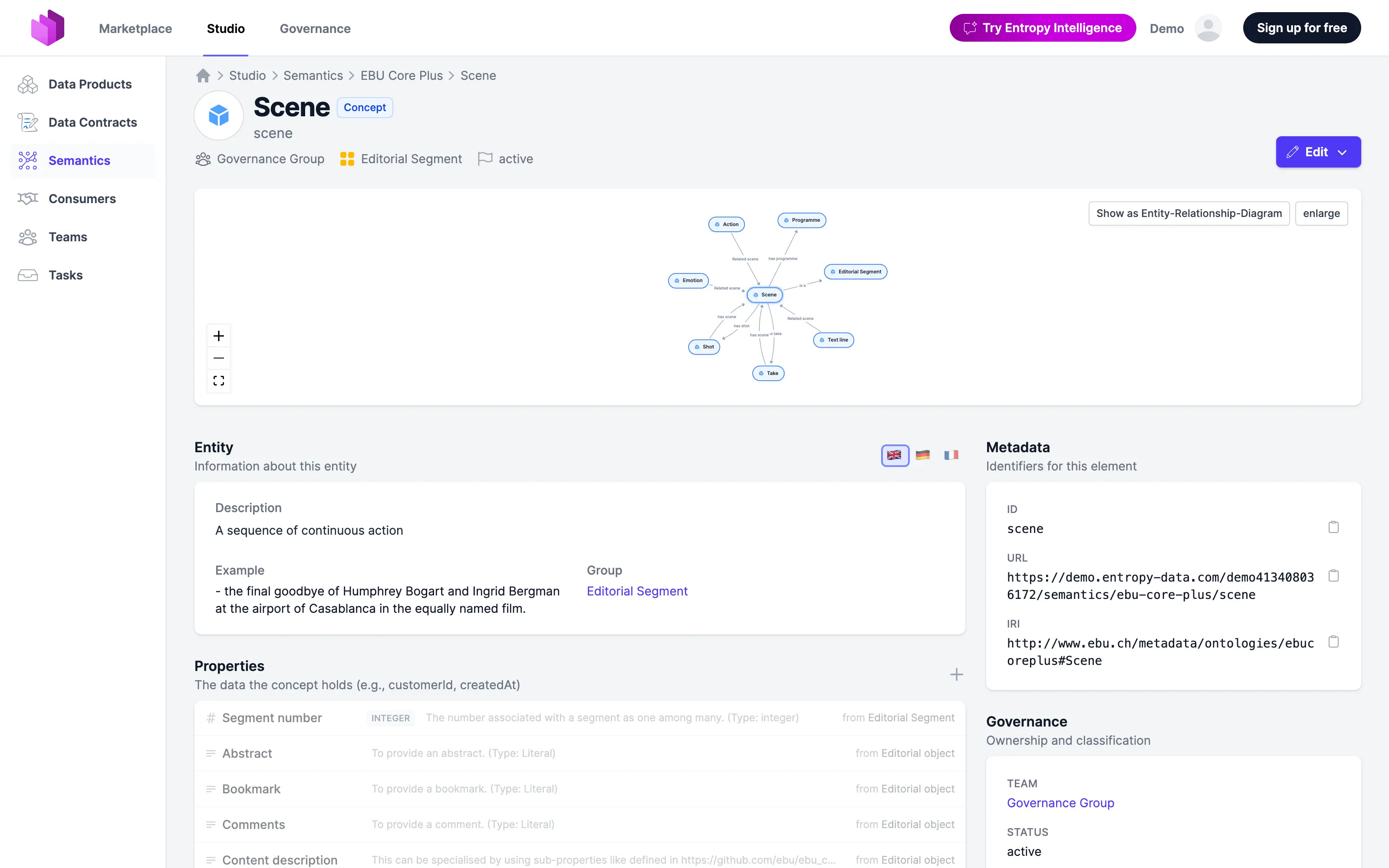
Each concept has a stable ID, a human-readable name, a description, and an IRI so it can be referenced from external tools. For example, the Editorial Object concept from EBU Core Plus has the IRI:
http://www.ebu.ch/metadata/ontologies/ebucoreplus#EditorialObject
Concepts live in namespaces (the default is main) and come in four kinds:
- Entity (
EntityType): the nouns of your domain. Customer, Order, Article, Shipment. - Property (
ValueType): an attribute with a primitive type. Markedshared: true, it becomes a reusable shared property that attaches to one or more entities: Customer Email, SKU, Order ID. Defined once, referenced from multiple places. - Metric (
MetricType): a measurable quantity with a unit, a "better when" direction, and an optional formula. Gross Merchandise Value, Conversion Rate, Order Fulfillment Time. - Group (
GroupType): a container to organize concepts by domain or subject area. Sales, Fulfillment, Catalog, Controlling.
Concepts carry the metadata that governance and AI tooling depend on: data type, classification (for example PII, sensitive, restricted), required and unique flags, examples, enums, regex patterns, multi-language names and descriptions, and tags.
Concepts as YAML
The full ontology can be edited as YAML, which is practical for bulk edits, code review, and keeping the ontology in Git. Individual concepts also have a per-concept YAML editor. The format follows the Apache Ossie ontology specification. An excerpt from the demo retail ontology:
version: 0.2.0.dev0
name: main
ontology:
  - concept: Order
    id: order
    type: EntityType
    group: Sales
    description: A confirmed purchase placed by a customer in the online shop.
    custom_properties:
      owl:equivalentClass: http://schema.org/Order
    relationships:
      - name: order_id
        type: hasProperty
        roles:
          - concept: Order ID
      - name: customer_id
        type: hasProperty
        roles:
          - concept: Customer ID
      - name: order_status
        type: hasProperty
        roles:
          - concept: order_status
      - name: currency
        type: hasProperty
        roles:
          - concept: currency
  - concept: order_status
    id: order.order-status
    type: ValueType
    extends:
      - String
    description: Lifecycle state of the order.
    enum: [pending, confirmed, shipped, delivered, cancelled, returned]
  - concept: currency
    id: order.currency
    type: ValueType
    extends:
      - String
    description: ISO 4217 currency code of the order total.
    pattern: ^[A-Z]{3}$
    examples: [EUR, USD]
Three details are worth pointing out. An entity references its properties through hasProperty relationships: Order ID and Customer ID are shared properties defined once with shared: true and reused across entities, while order_status and currency are properties of the order, each a ValueType component of its own. A property expresses its datatype by extending a built-in value type such as String, Decimal, or DateTime. And the owl:equivalentClass entry in custom_properties aligns the concept with an external ontology (schema.org in this case), which keeps the internal model interoperable with standards such as GoodRelations or FIBO.
Metrics with formulas
A metric records its unit, the direction in which it improves, and how it is computed. That gives Finance, Product, and AI tools a single definition to agree on.
ontology:
  - concept: Gross Merchandise Value
    id: gmv
    type: MetricType
    group: Controlling
    description: Total value of all placed orders before refunds, returns, and discounts.
    unit: EUR
    better_when: higher
    formula: "SUM(order.total_amount)"

  - concept: Average Order Value
    id: average_order_value
    type: MetricType
    group: Sales
    unit: EUR
    better_when: higher
    formula: "SUM(order.total_amount) / COUNT(DISTINCT order.id)"
Relationships
Concepts connect to each other through directed, typed relationships. The common types are hasProperty, relatedTo, measures, and derived_from; subtyping is expressed with extends. A relationship is authored on the concept that plays its first role, so that concept is implicit: roles lists only the remaining participants, and verbalizes carries natural-language patterns that AI agents can use.
ontology:
  - concept: Customer
    relationships:
      - id: customer_places_order
        name: places
        type: relatedTo
        roles:
          - concept: Order
        multiplicity: OneToMany
        verbalizes:
          - "{Customer} places {Order}"

  - concept: Average Order Value
    relationships:
      - id: aov_derived_from_gmv
        name: derived_from
        type: derived_from
        roles:
          - concept: Gross Merchandise Value
        verbalizes:
          - "{Average Order Value} derived from {Gross Merchandise Value}"
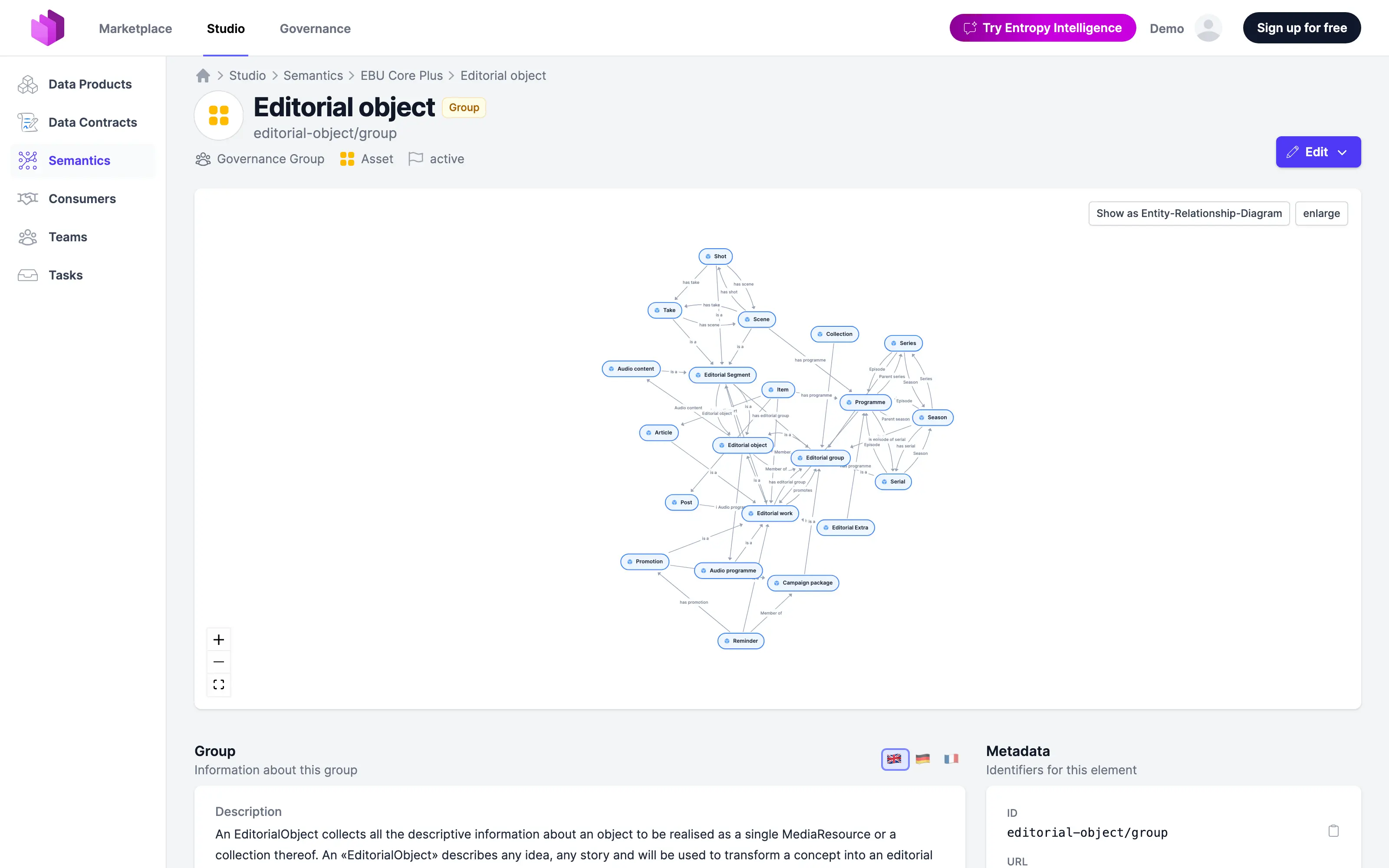
Each concept page shows incoming and outgoing edges so you can navigate the ontology in either direction. The Diagram view shown at the top of this page renders the same namespace as an interactive graph, with pan, zoom, and a click-through from any node to its concept page.
Translations in multiple languages
Each concept, property, and relationship can carry translations of its name and description in any number of languages. Translations are stored as language-tagged custom_properties entries such as name@de or description@fr, exposed through the SPARQL endpoint, and shown in the UI based on the user's language preference. A single ontology can serve English-speaking analysts, French-speaking product managers, and German-speaking auditors from the same source.
ontology:
  - concept: Customer
    id: customer
    type: EntityType
    group: Customers
    description: A natural person who places orders in the online shop.
    custom_properties:
      name@de: Kunde
      name@fr: Client
      description@de: Eine natürliche Person, die Bestellungen im Online-Shop aufgibt.
      description@fr: Une personne physique qui passe des commandes dans la boutique en ligne.
The industry ontologies that ship with Entropy Data are translated out of the box. EBU Core Plus, for example, comes with English, German, and French labels and descriptions for every class and property.
Linking data products and data contracts
A semantic layer is only useful if the data that implements it points back to it. Entropy Data uses the authoritativeDefinitions mechanism from the Open Data Contract Standard to connect concepts to the implementing data at three levels:
- On a data product (ODPS), representing the data product as a whole.
- On a data contract or one of its schema objects.
- On a specific field inside a contract schema.
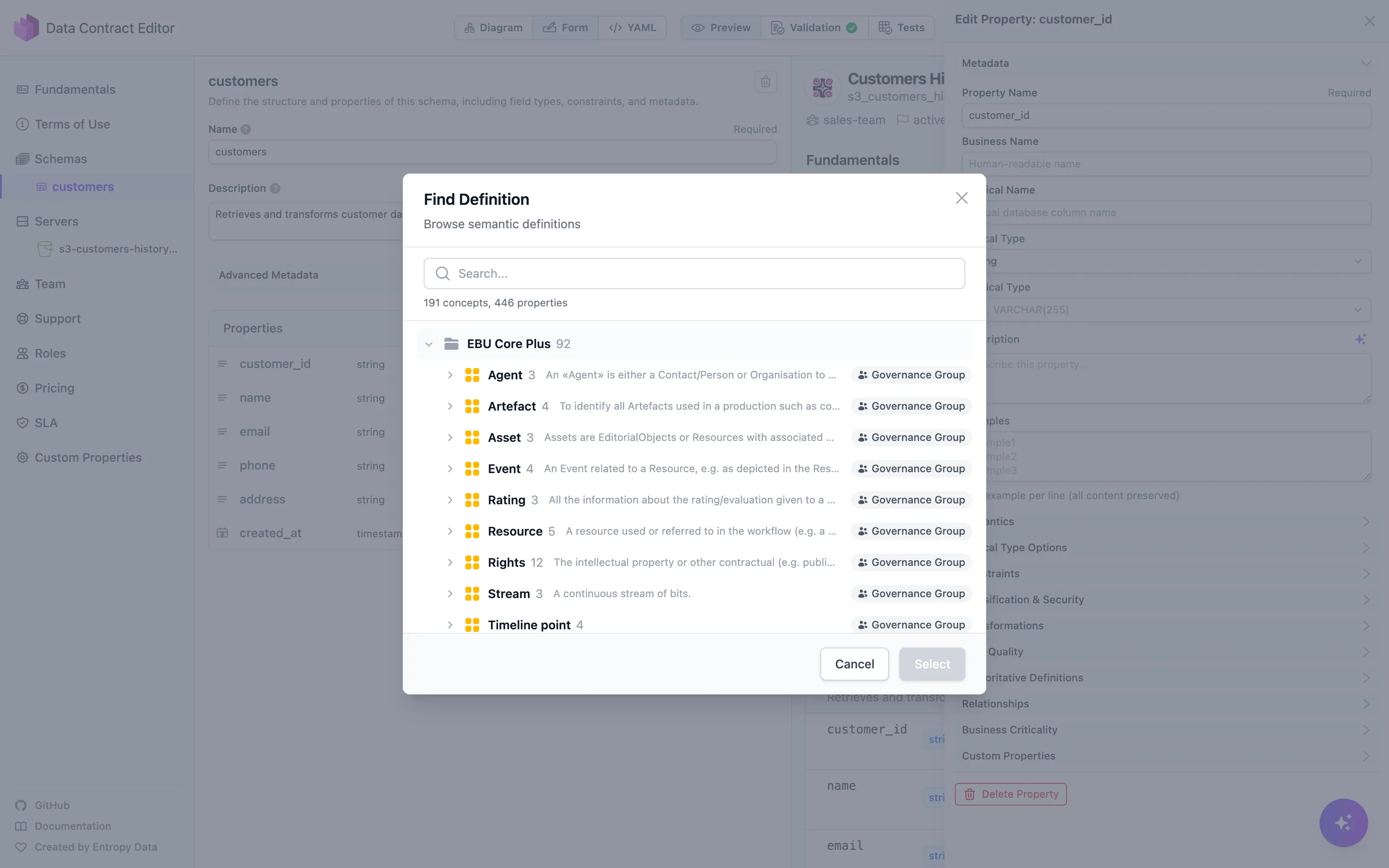
The same link can be written directly into ODCS YAML. From a demo shipments contract:
properties:
  - name: shipment_id
    businessName: Shipment ID
    logicalType: string
    primaryKey: true
    authoritativeDefinitions:
      - type: "semantics"
        url: "https://demo.entropy-data.com/my-organization/semantics/main/shipment_id"
  - name: order_id
    authoritativeDefinitions:
      - type: "semantics"
        url: "https://demo.entropy-data.com/my-organization/semantics/main/order_id"
The type: "semantics" marker tells Entropy Data the URL resolves to a semantic concept, and the link is rendered as a clickable reference on the contract page. On the concept page, Entropy Data lists every data product and data contract that references it, so questions like "which datasets contain customer email addresses?" can be answered directly.
What Semantics is useful for
Discovery by meaning
Consumers search for Shipment and find every data product that implements that concept, regardless of how the underlying columns are named.
Consistent definitions across teams
One Customer Email definition is referenced by multiple data contracts. Changing its classification to sensitive updates every reference.
A single source of truth for metrics
GMV, Conversion Rate, and the contribution margins have canonical definitions with formulas, which removes the ambiguity that tends to accumulate in spreadsheets.
Context for AI agents
LLMs do not know what your business means by Active Customer or Contribution Margin 2. When agents access data through our MCP server, Semantics supplies that context, so they join on the right keys and use the right metric definitions.
Start with an industry ontology
You do not need to model your domain from scratch. Entropy Data ships with ready-to-import ontologies for several industries. Open Studio, go to Semantics, and use Add → Import Industry Standard:
- GoodRelations (E-Commerce)
- FIBO (Finance)
- EBU Core Plus (Media)
- CGMES (Energy)
- IDMP (Pharma)
- EPCIS (Supply Chain)
- IATA ONE Record (Air Cargo)
- TM Forum SID (Telco)
You can also upload your own RDF/OWL files (Turtle, OWL, RDF/XML, N-Triples, N3, JSON-LD), or query the ontology programmatically via the SPARQL endpoint at /api/semantics/sparql.
Open standards: Apache Ossie
Entropy Data is committed to open standards for the semantic layer and has joined the Apache Ossie project, formerly known as the Open Semantic Interchange (OSI) initiative. Apache Ossie is a vendor-agnostic, open-source effort to standardize how semantic models are exchanged between BI platforms, AI agents, and analytics tools, so that a single definition of an entity or metric stays consistent across your ecosystem. We will support the upcoming Ossie Ontology standard natively in Semantics, next to our support for Bitol's Open Data Contract Standard and Open Data Product Standard on the data contract and data product side.
How Semantics fits the rest of Entropy Data
- Marketplace uses semantic concepts for discovery.
- Studio is where domain experts and data product owners curate concepts and link them to contracts.
- Governance reuses semantic classifications (PII, sensitive, and so on) in cross-cutting policies.
- The MCP server uses Semantics to ground LLM tool calls in your business vocabulary.
Getting started
Semantics is available behind a feature flag:
- Entropy Data Cloud: contact us to enable it for your organization.
- Self-hosted: set
APPLICATION_SEMANTICS_ENABLED=trueand restart the application.
To try Semantics without installing anything, open the Demo and go to Studio → Semantics. The demo ships with major industry standards: Go to Studio → Semantics → Add → Import Ontology to explore provided industry standards or to upload your own existing ontology.
About the author
Jochen Christ
LinkedIn of Jochen ChristCo-Founder & CTO, Entropy Data
Jochen builds tools that help data, people, and AI work together. He is the author of the Data Mesh Architecture website, maintainer of the Data Contract CLI, and a TSC member of the Linux Foundation's Bitol project, home of the Open Data Contract Standard.