Webinar · BCS Data Management Specialist Group
Human-ready and AI-ready Data with Data Contracts
Dr. Simon Harrer (CEO & Co-Founder, Entropy Data) ·
A lunchtime webinar for the Data Management Specialist Group of BCS, The Chartered Institute for IT. Simon explains what a data contract is, what goes into one with the Open Data Contract Standard, and why the point of a contract is automation, not documentation. A live demo then shows the use case that touches everything at once: a coding agent that builds a data product from a contract, finds the data to build on in a marketplace, and tests its own result against the contract.
The annotation below is an edited summary of the webinar and its Q&A.
TL;DR
Five key points and lessons learned from the webinar.
-
Think of an API, but for data. A data contract states who owns the data, how it is structured, what it means, which quality is guaranteed, and what consumers may do with it. The producer owns it, and consumers read it to decide whether they can trust the data.
-
There is one open standard now. The Open Data Contract Standard started as a PayPal format and became vendor-neutral at the Linux Foundation with version 3. It covers fundamentals, schema, quality, team, terms of use, SLAs, and servers.
-
Automate the hell out of it. The Data Contract CLI tests the data against the contract: on every commit in CI/CD, and every night in production. That gives you data quality monitoring for free, once the contract exists.
-
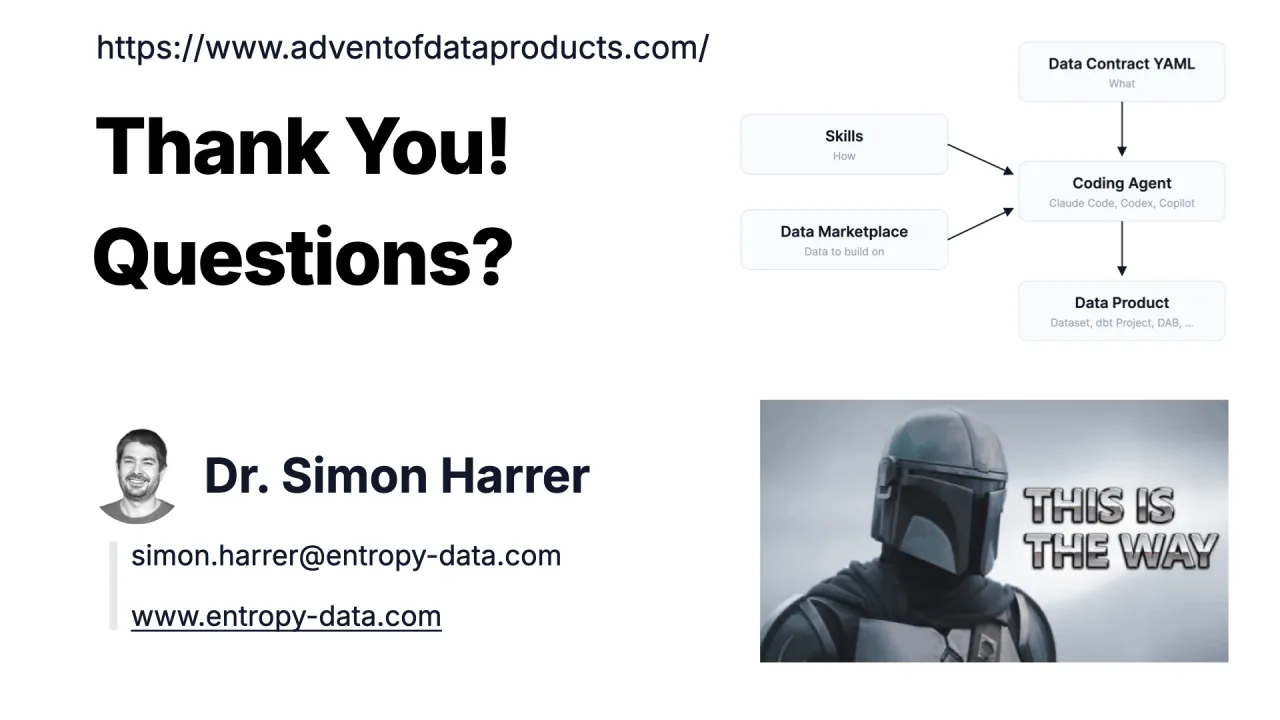
Write the contract first, and the agent builds the pipeline. With a contract (what), skills (how), and a marketplace (the data to build on), a coding agent found three upstream data products, requested access, built and ran the pipeline, and checked it against the contract in about seven minutes.
-
Semantics make it work. Columns linked to a shared ontology tell the agent which data means the same thing across contracts, so it knows how to join and transform. Ontologies are being redefined as business data models, and Apache Ossie is where that is being standardized.
The Speaker
Simon Harrer is a software engineer at heart, from the days "when you coded yourself". He co-wrote a book on Java and clean code, Java by Comparison. "No one's reading that anymore", but it was among the pirated books in the lawsuit against Anthropic, so what he put into it lives on in frontier models.
He moved into data with the rise of Data Mesh, translated the Data Mesh book into German ("so I had to read that book at least once, which is quite thick"), and publishes free material on Data Mesh and data contracts, most recently Entropy Explains, a series of two-minute animated videos.
He sits on the Technical Steering Committee at the Linux Foundation that drives the industry standards for data contracts and data products, and he co-maintains the Data Contract CLI, the open-source tool that reads contracts in that standard. Both are the focus of the webinar.
What Is a Data Contract?
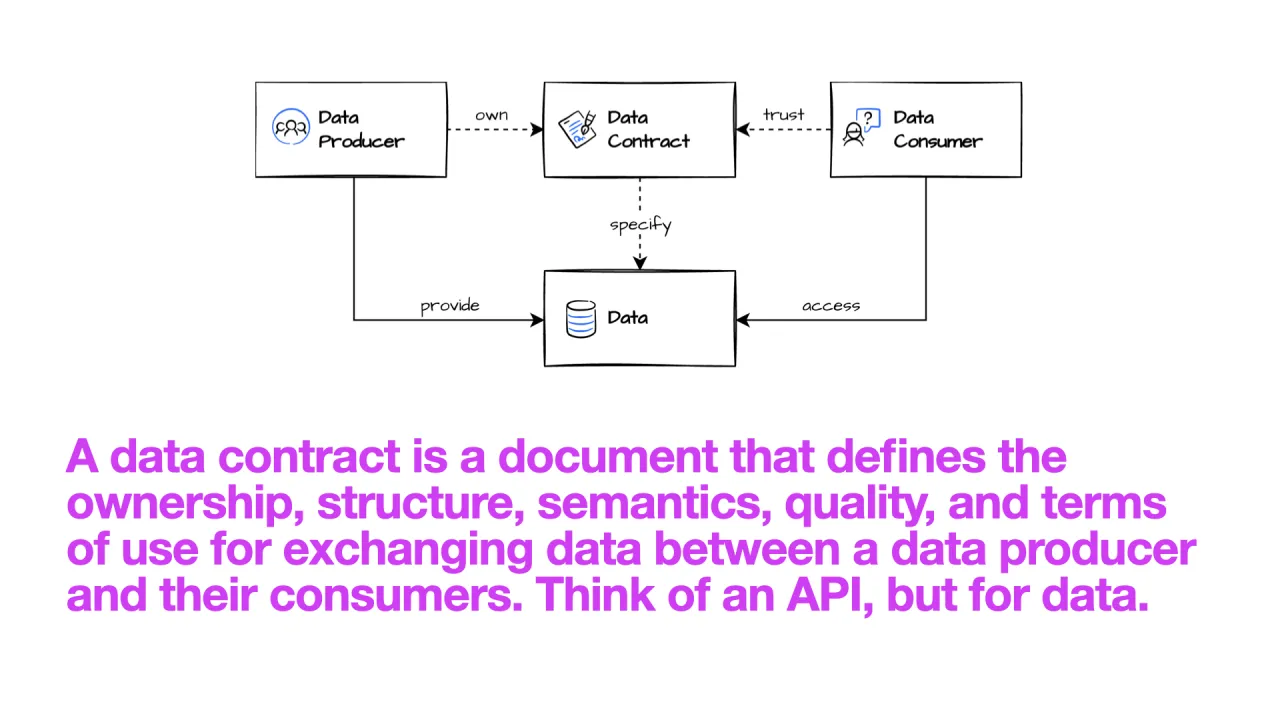
A data contract sits between a data producer and its consumers. It is a document that defines who owns the data, how it is structured, what it means, which quality is guaranteed, and the terms of use: what you may and may not do with the data.
The producer owns the contract for the data it shares. The consumer reads the contract, decides whether it can trust the data, and then accesses it.
That is API thinking. In software engineering, an API comes with an API specification, and you decide based on the specification whether to use the API. A data contract does the same for data.
From PayPal to an Open Standard
The problem is not new, but for a long time there was no standard way to write a data contract down. Several companies decided that guarantees about data, in a machine-readable format that consumers can trust and automate, were a good idea, and each created its own format.
One of them was PayPal. It open-sourced its YAML format and donated it to the Linux Foundation. But the format was very PayPal-specific: PayPal used BigQuery, and if you used Databricks, Snowflake, SQL Server, or Postgres, it did not work well.
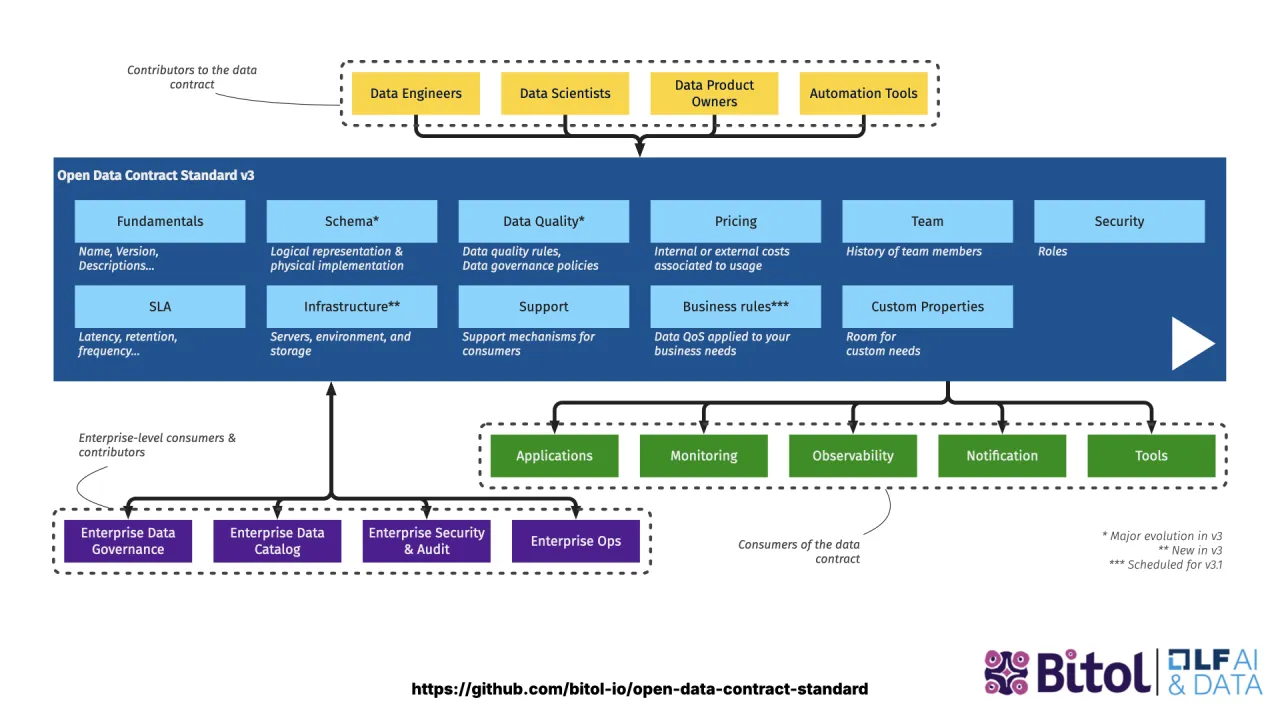
Simon joined the steering committee at that point and helped make the format usable for every company, not just PayPal. The result was version 3 of the Open Data Contract Standard (ODCS), which has a section for each kind of promise a data owner can make.
What Goes Into a Contract
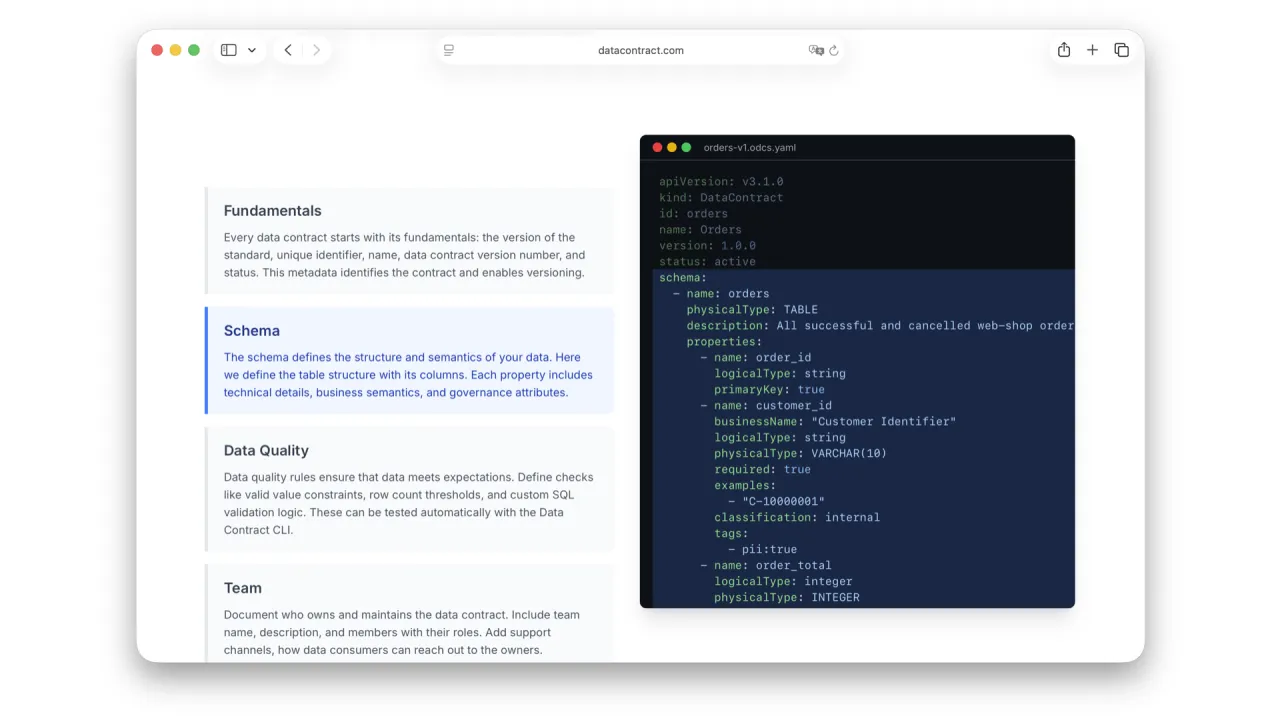
- Fundamentals: name and ID, plus a version, typically semantic versioning, and a status. With the status you can phase contracts in and phase them out.
- Schema: the key part. It describes the tables and their fields and what is guaranteed about them, including technical details. If the contract promises that
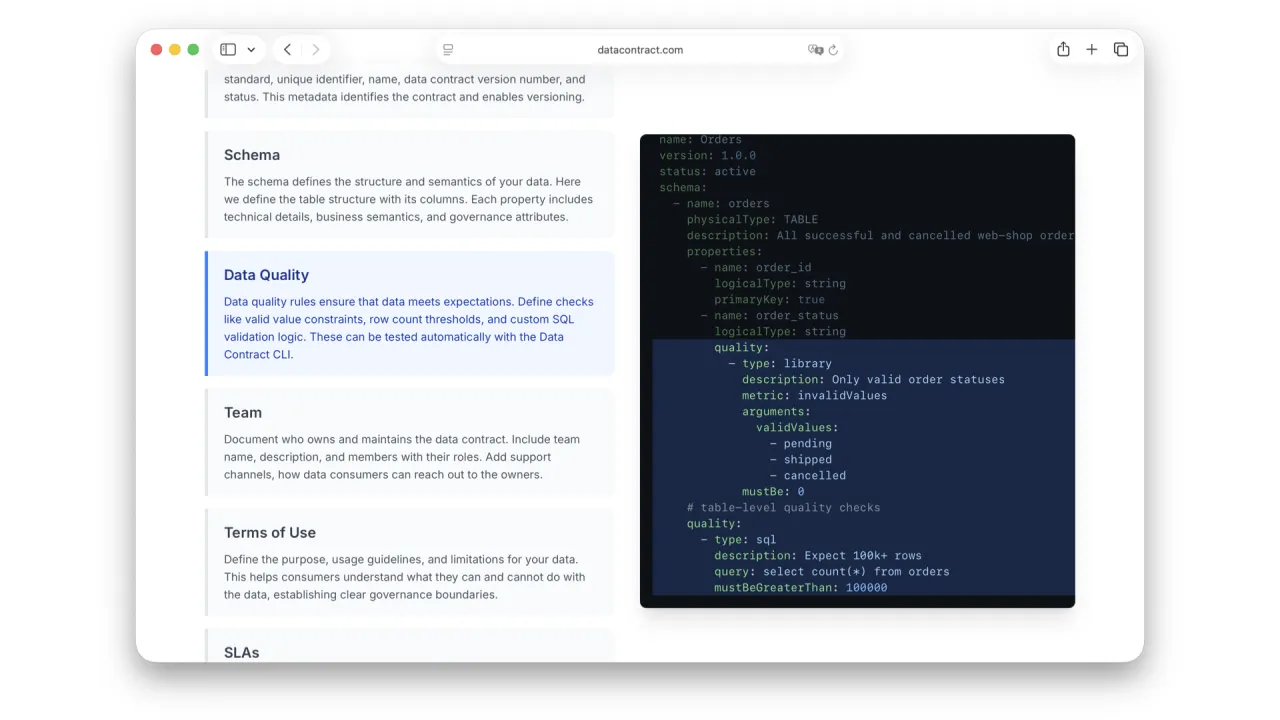
customer_idis aVARCHAR(10)and it is not, the data is in violation of the contract. You can add examples, classifications, and tags, for example to mark personally identifiable information. "That's just the tip of the iceberg." - Data quality: checks the provider promises, for example that the order status only takes the values pending, shipped, and cancelled, or that the dataset has at least 100,000 rows. Consumers can rely on those promises.
- Team: who owns the data and is responsible, and how to reach them through Slack or Teams channels, Jira, or email.
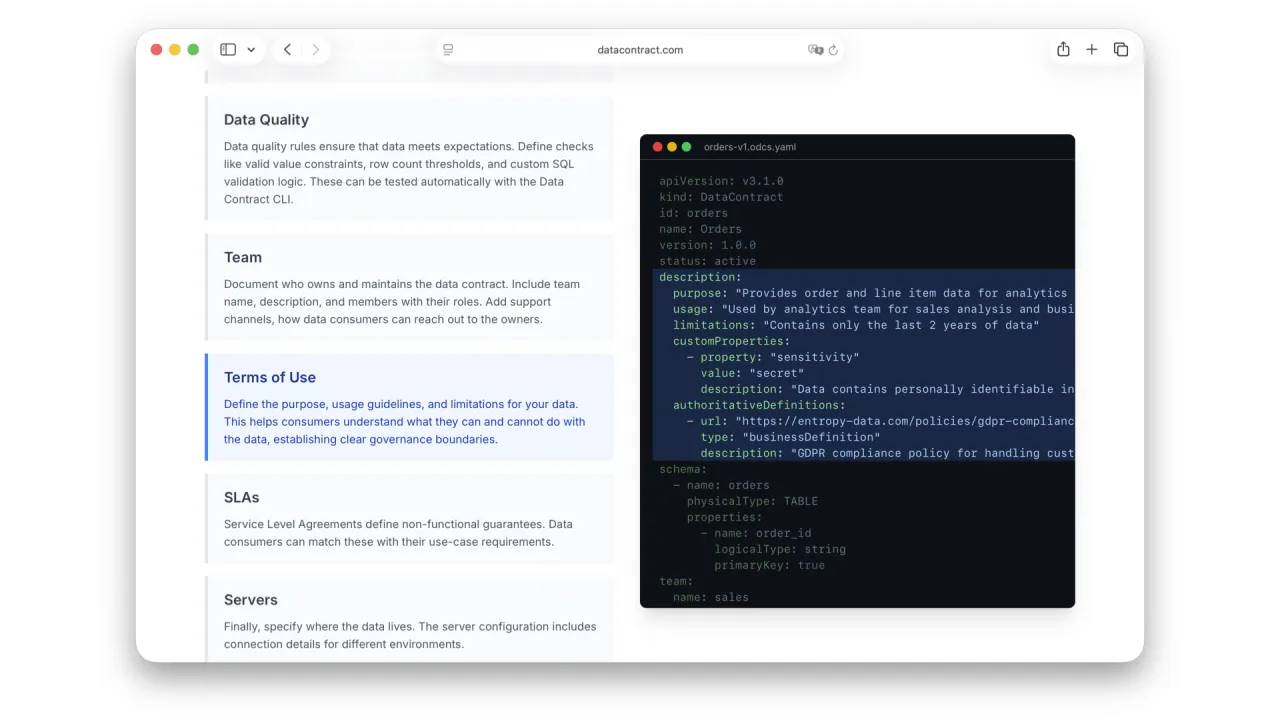
- Terms of use: why the data is shared, and what the limitations are. Think of data bought from another company: it always comes with a license agreement. Consumers can check whether what they want to do is allowed.
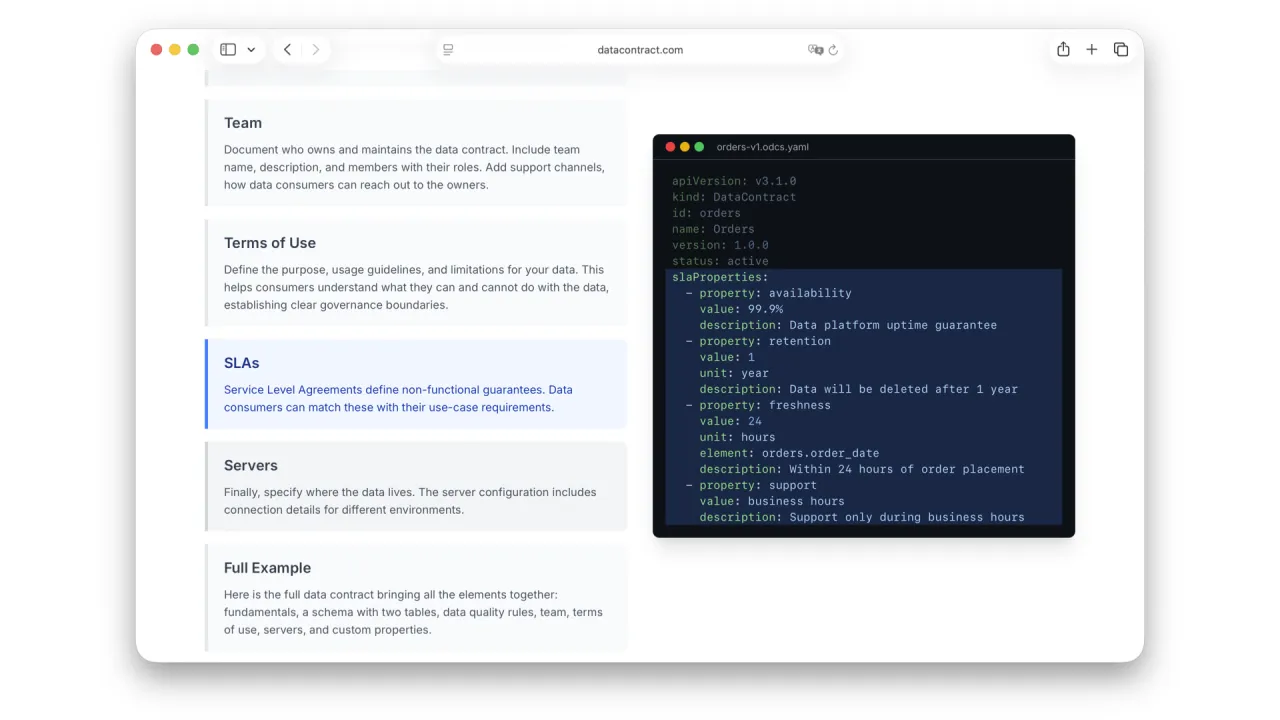
- SLAs: promises on freshness, retention, or latency, which can also be checked automatically.
- Servers: where the data actually lives, so the consumer immediately knows the host, port, database, and schema. The standard supports all the commonly used data locations.
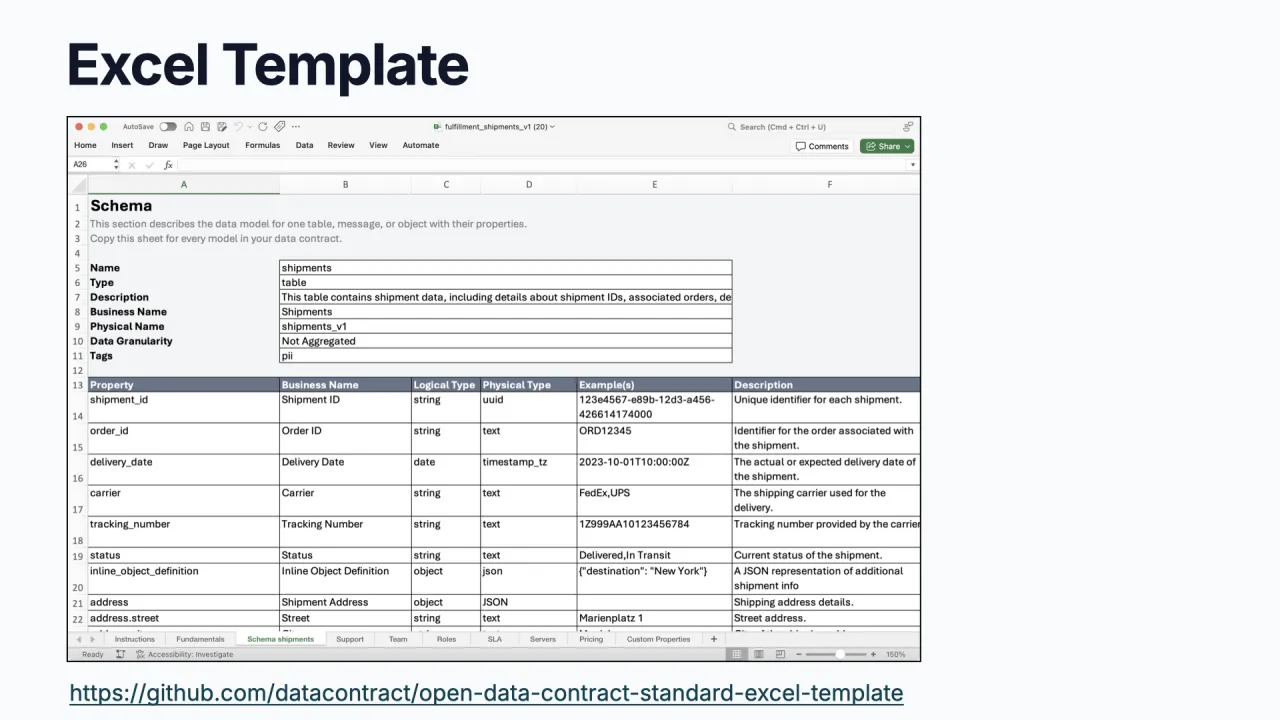
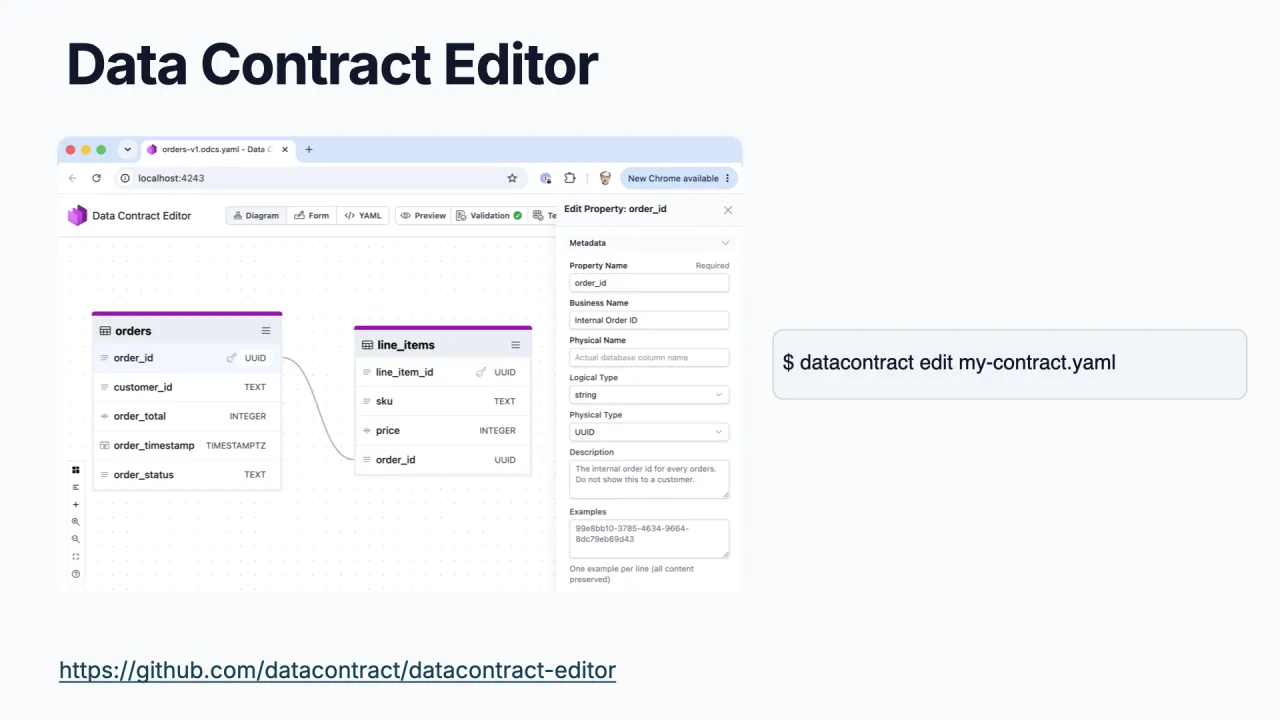
YAML, Excel, or Editor
You can write the YAML yourself. You can also type it into the ODCS Excel template and convert it to YAML, which is surprisingly popular, "because Excel just never dies".
The open-source Data Contract Editor lets you create a contract in a guided, drag-and-drop way. However you create it, the YAML file is what counts.
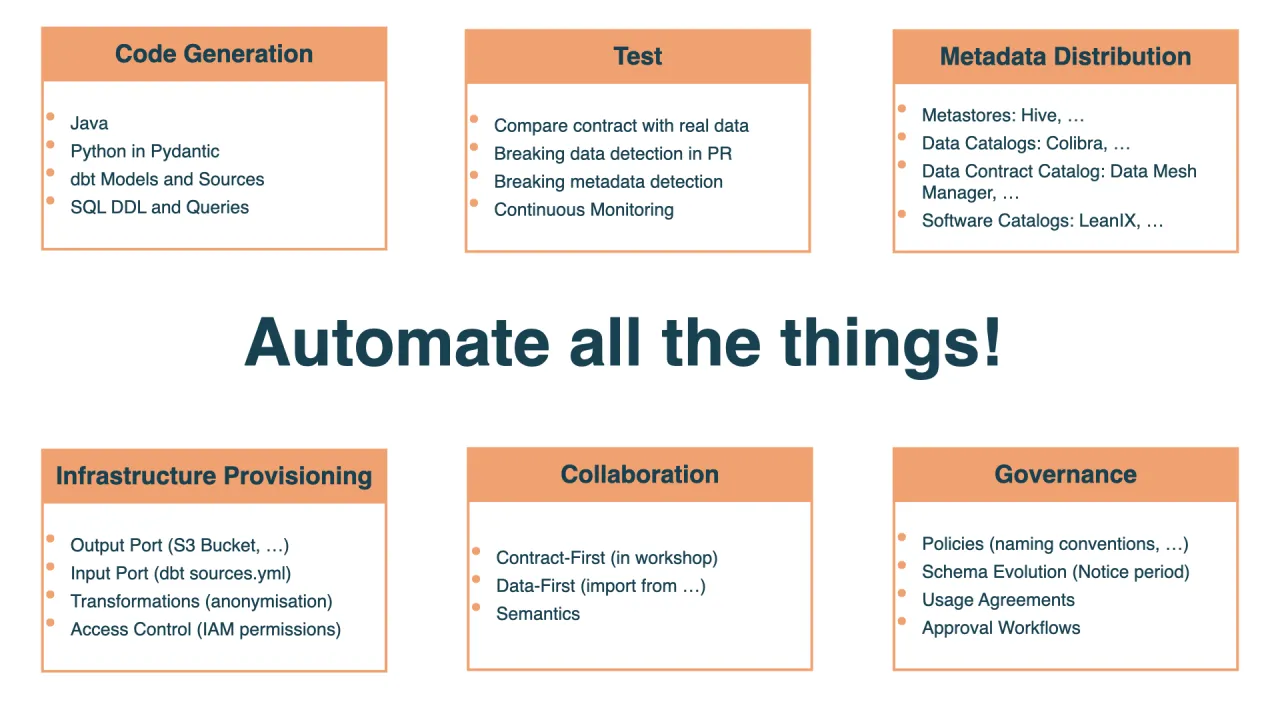
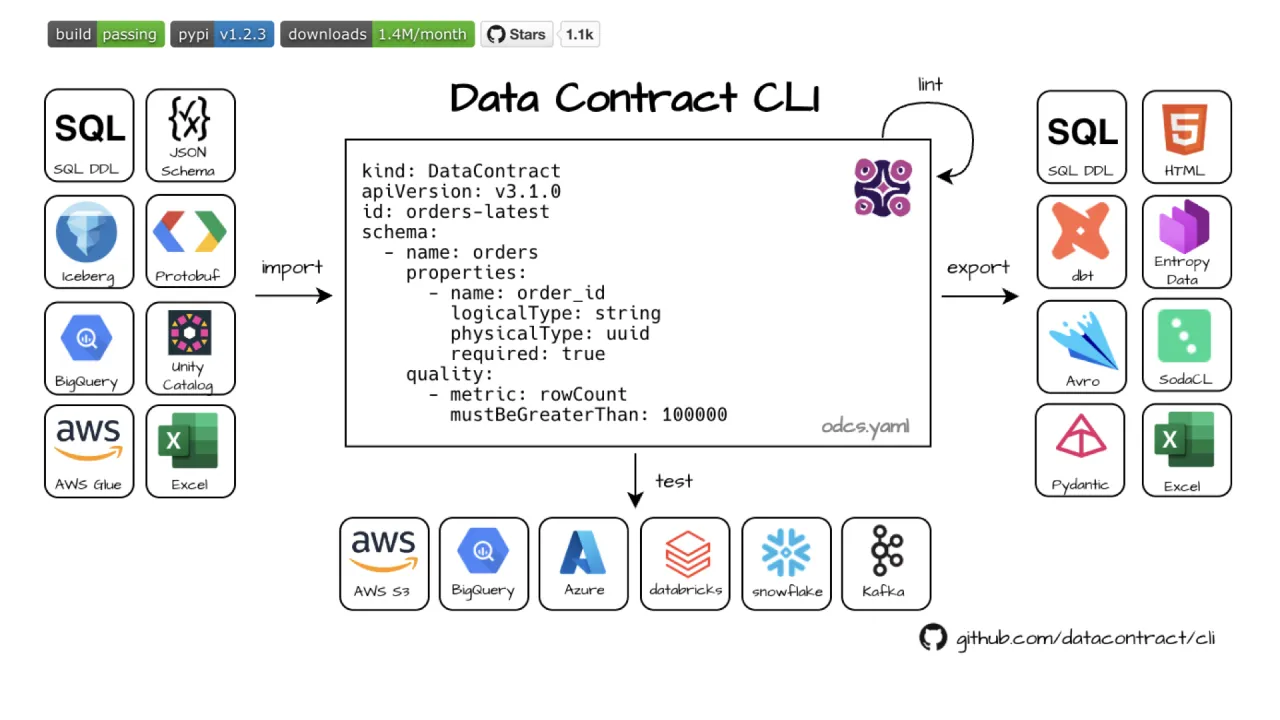
Automation, Not Documentation
The aim of a contract is not documentation. "It's automation. We want to automate the hell out of it." You can generate code from it, such as dbt models or SQL DDL. But the most important use is testing: read the contract, read the data, and check whether the data matches the guarantees.
For that, the team built the open-source Data Contract CLI in Python. It reads an ODCS contract, connects to the data source, runs SQL queries on the data, and reports whether the data keeps the contract's promises. It has more than a million downloads per month.
There are two core places to run it:
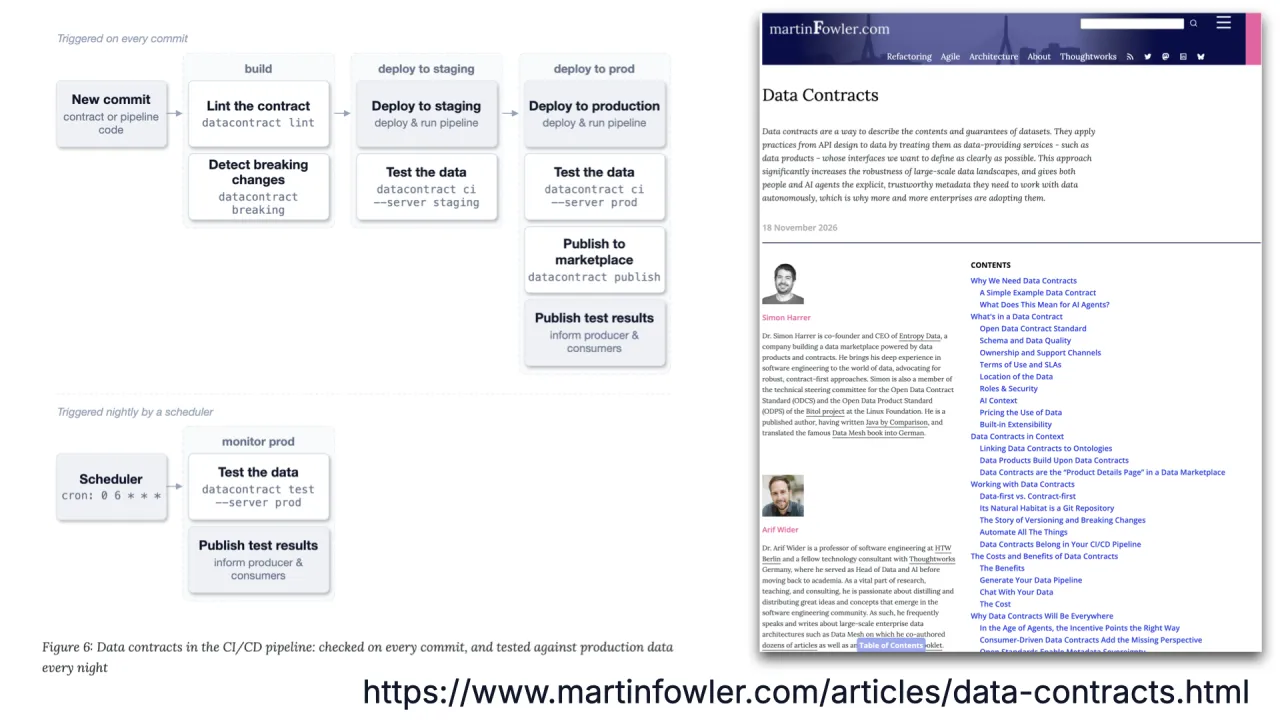
- On every commit in CI/CD, when you work on the pipeline that produces the data: lint the contract against the rules of the standard, detect breaking changes you did not intend, test against staging and production, and publish the result to a central place.
- Every day in production, as monitoring of the guarantees you give your consumers. That is data observability, and "you get it out of having a contract basically for free".
The pipeline figure comes from Data Contracts, the article by Simon Harrer and Arif Wider that martinfowler.com published a week before the webinar.
Contract First, With a Coding Agent
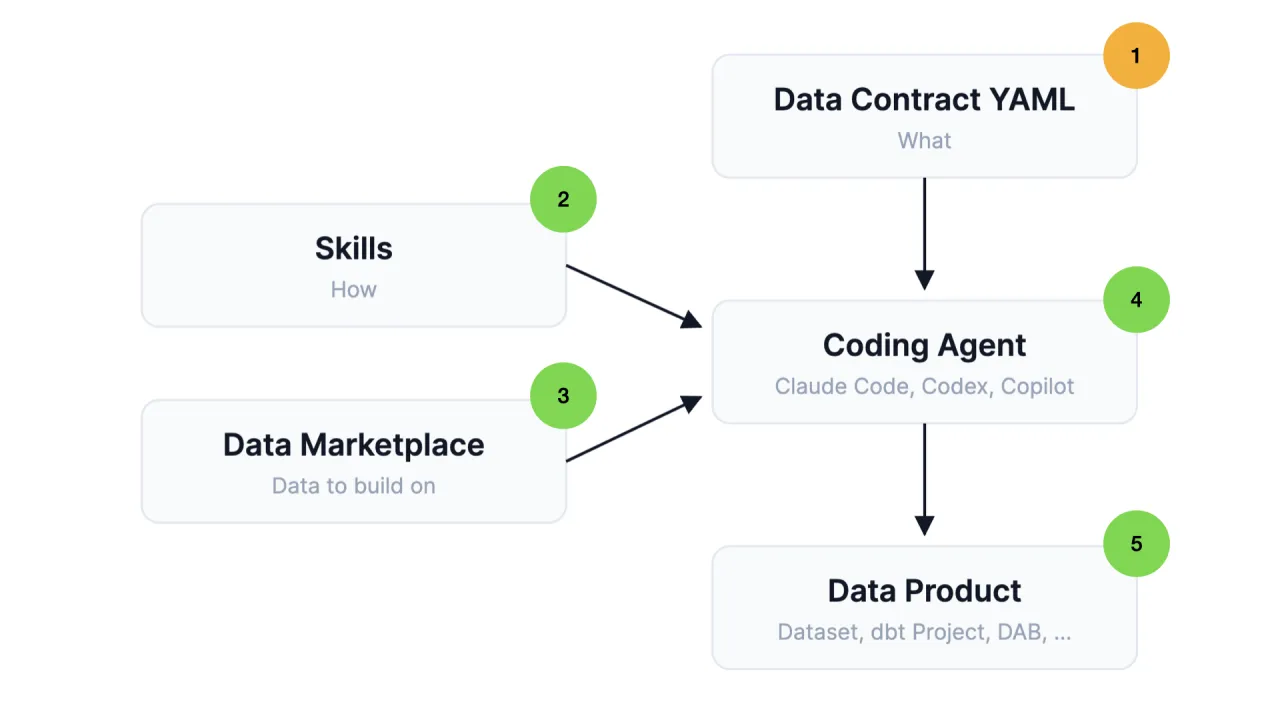
The demo shows the use case Simon finds most interesting right now, because it touches so many things: building a data product, the pipeline that transforms and processes data. You can do that by hand. But today people typically let a coding agent implement the pipeline, and the agent needs to know what to build.
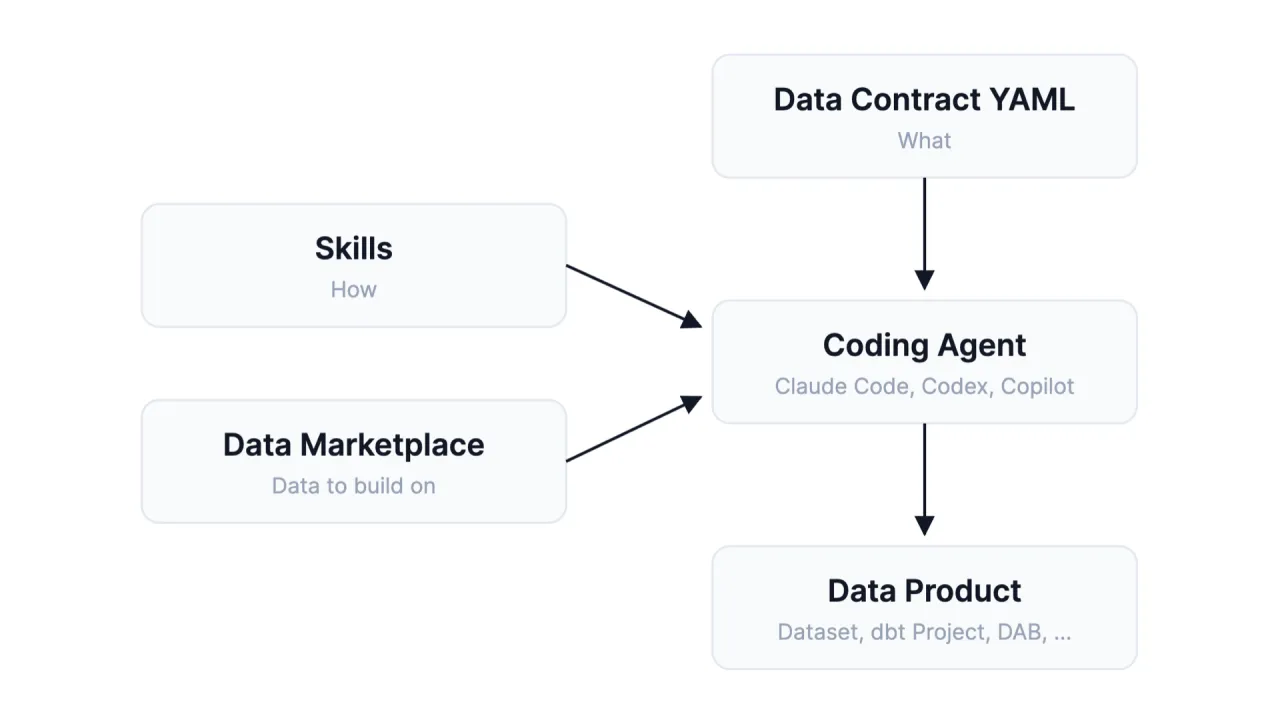
The contract is perfectly placed for that, because you can write it before the pipeline, or even the table, exists. "It's like a cruise control. You set 60 miles an hour, and the car makes it a reality." You write the contract, start the agent, and the agent makes it a reality.
For that to work, the agent needs three inputs: a good contract with a lot of information (what), a skills repository that encodes how to build it, and a data marketplace that tells it which data products and contracts already exist to build on.
Live Demo: The Contract and One Prompt
The setting is e-commerce, and the question is how big the problem of shelf warmers is per brand. Simon creates a new contract, shelf-warmers-per-brand, in the open-source editor inside Entropy Data.
The table builds on existing semantics: the stock keeping unit and the brand are already defined, so he reuses those definitions for the new columns. Then come the number of unsold stock (an integer) and the date of the last sale. The server is Snowflake, with a new database for the data product. He saves it, renames table1 to shelf_warmers_per_brand, and has a contract: a YAML file following ODCS. "Think of that, what we just did, you could do in a workshop together with your business people."
Running the contract test with the Data Contract CLI fails, as it must: the table does not exist yet. So far it is just a little metadata. Next comes the data product, "basically a box that has this as an interface. Just think of it as an architectural container."
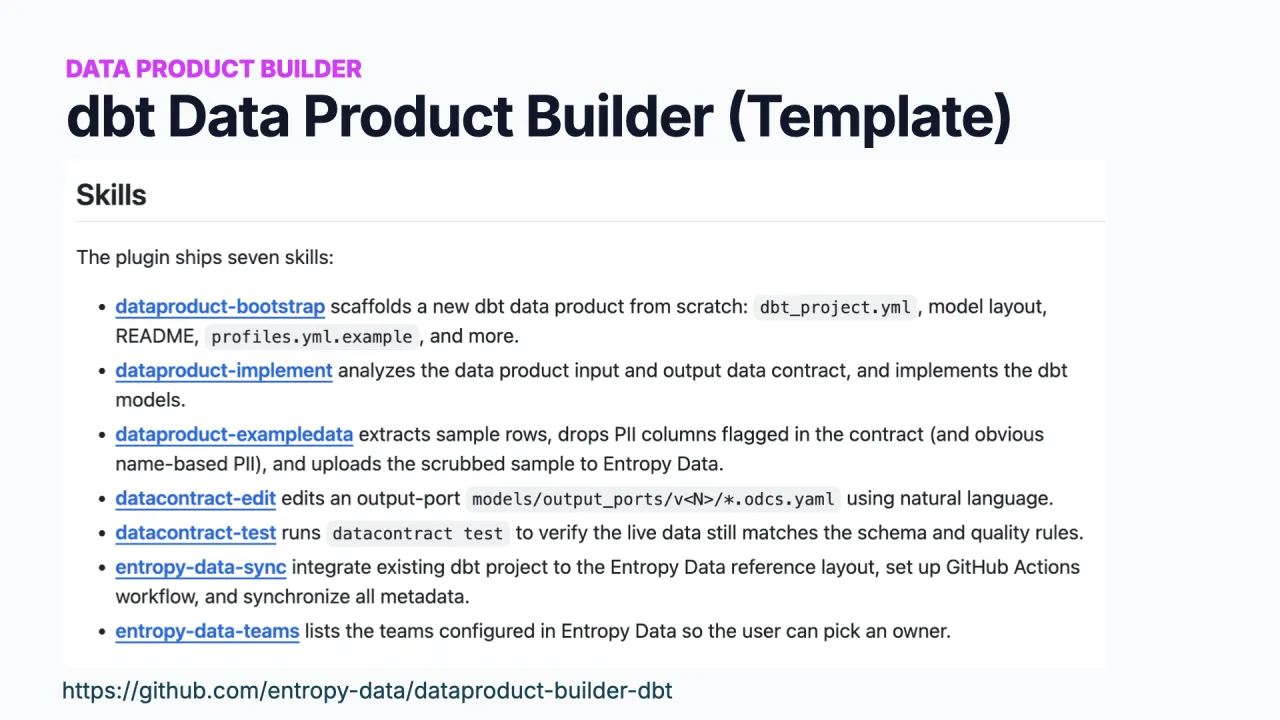
Then Claude Code gets the skills, the how. They live in a GitHub repository and are simply Markdown files with instructions, here a list of 13 steps to implement the pipeline. The demo uses dbt, but the approach works for any way of implementing a data pipeline. Last, the agent is connected to the marketplace, so it knows how to look up what is already there.
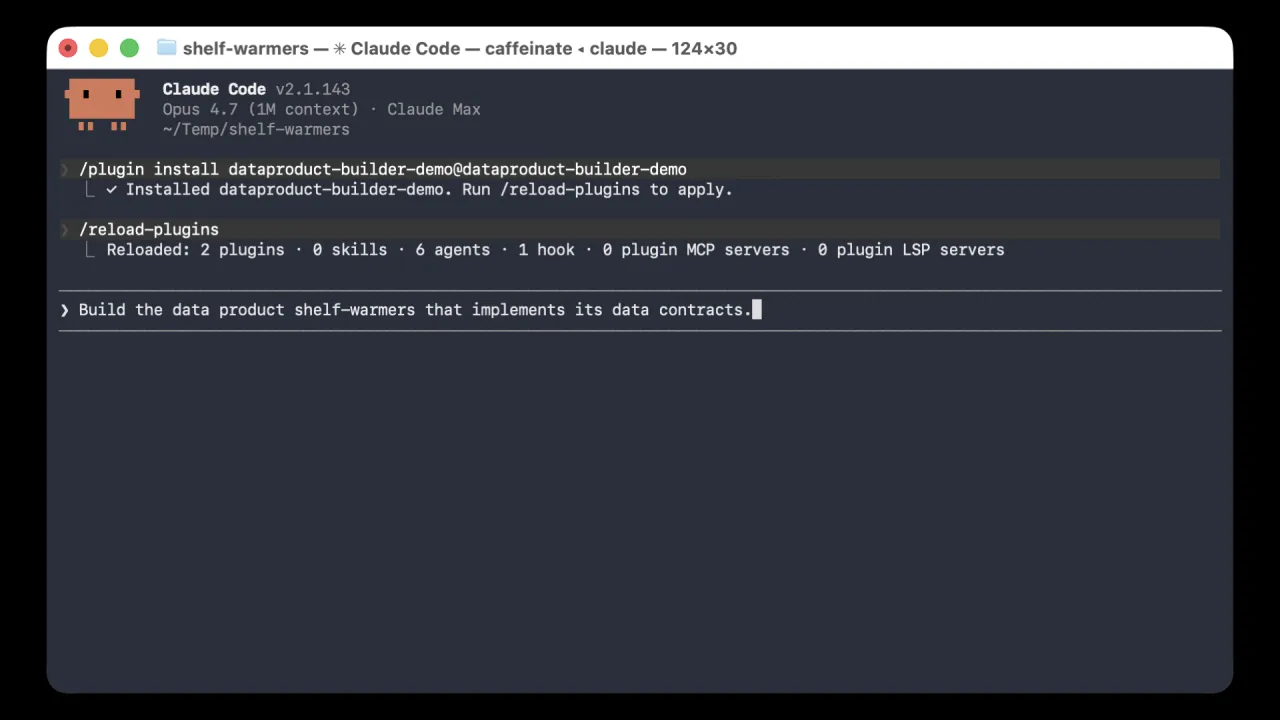
The prompt is: implement it. For the demo, Simon adds two lines: do not ask any questions, and approve access requests if you have the rights. "If the agent requests access to data, you typically still have a human in the loop."
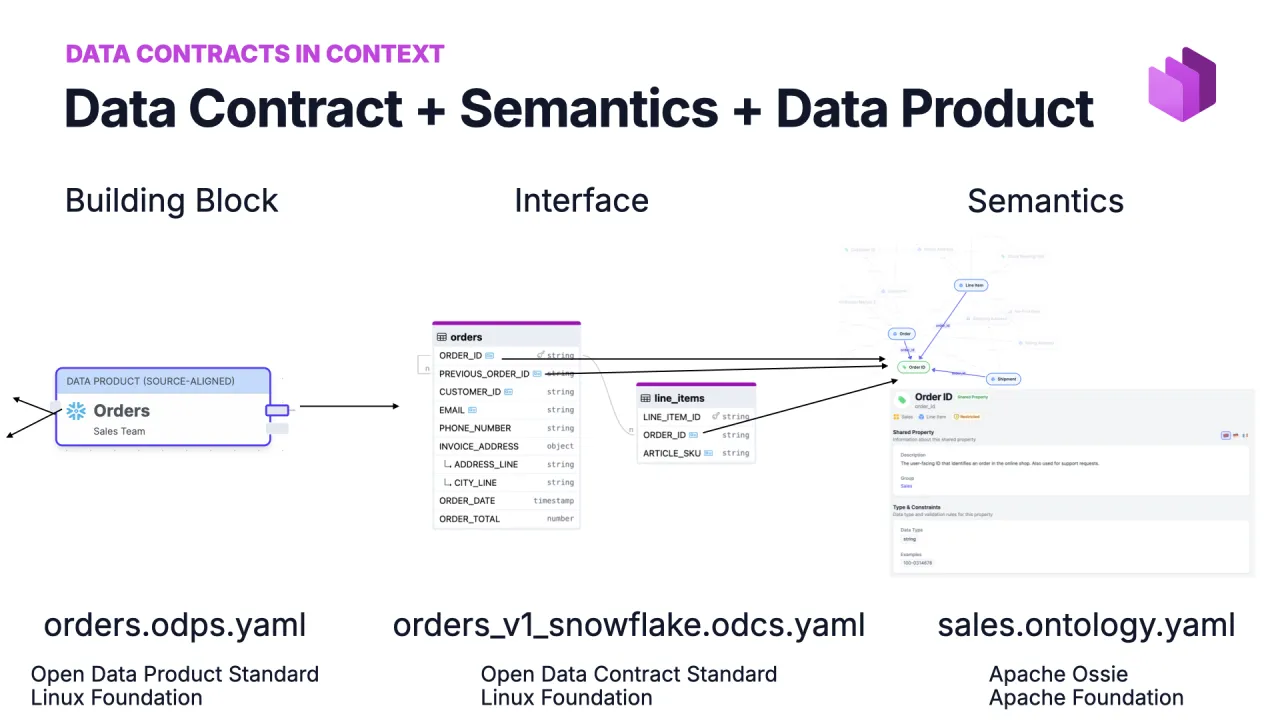
Contract + Semantics + Data Product
While the agent works, the slide shows the combination of standards behind it. In the middle is the data contract, the interface, in the Open Data Contract Standard. It is the interface of the data product being built, which uses the Open Data Product Standard. Both come from the Linux Foundation and work closely together.
On the other side, elements of the contract link into a semantic layer, an ontology. In the demo, the stock keeping unit and the brand are linked: the brand is a property of a product, the product has variants, which are articles, and those have the stock keeping unit. Other data products in the marketplace link to the same ontology. The agent follows those links to decide how to get the data for the new table. When several tables, or several contracts, point to the same concept, such as an order ID, the agent knows how to join and combine the data. The ontology standard here is Apache Ossie, which is getting a lot of traction.
Together, this metadata describes what we want. "Metadata first, contract first, however you want to call it. If you do that, the agent gives you the pipeline for free."
While building, the agent also uses the Data Contract CLI as a feedback loop: am I done? It can only be done when the data fulfills the contract. If there are still problems, it keeps going.
Live Demo: What the Agent Built
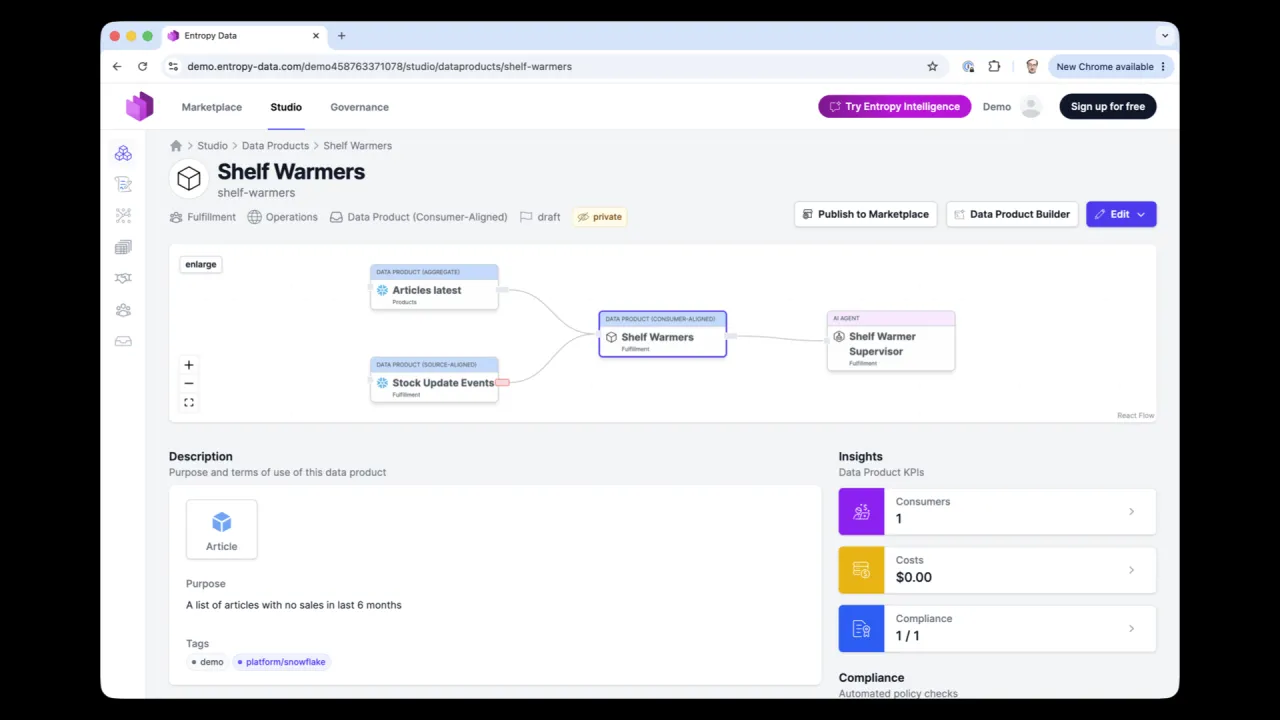
14,000 tokens in, the agent had bootstrapped the whole project. It had worked out that the new table needs three existing data products, shelf warmers, articles latest, and stock update events, and requested access to all three. "It found it out itself, it built the pipeline itself." At the start, the data product was just a box with the interface it promised. Now the marketplace shows it connected to its inputs, each with its own contract, all linked to the ontology.
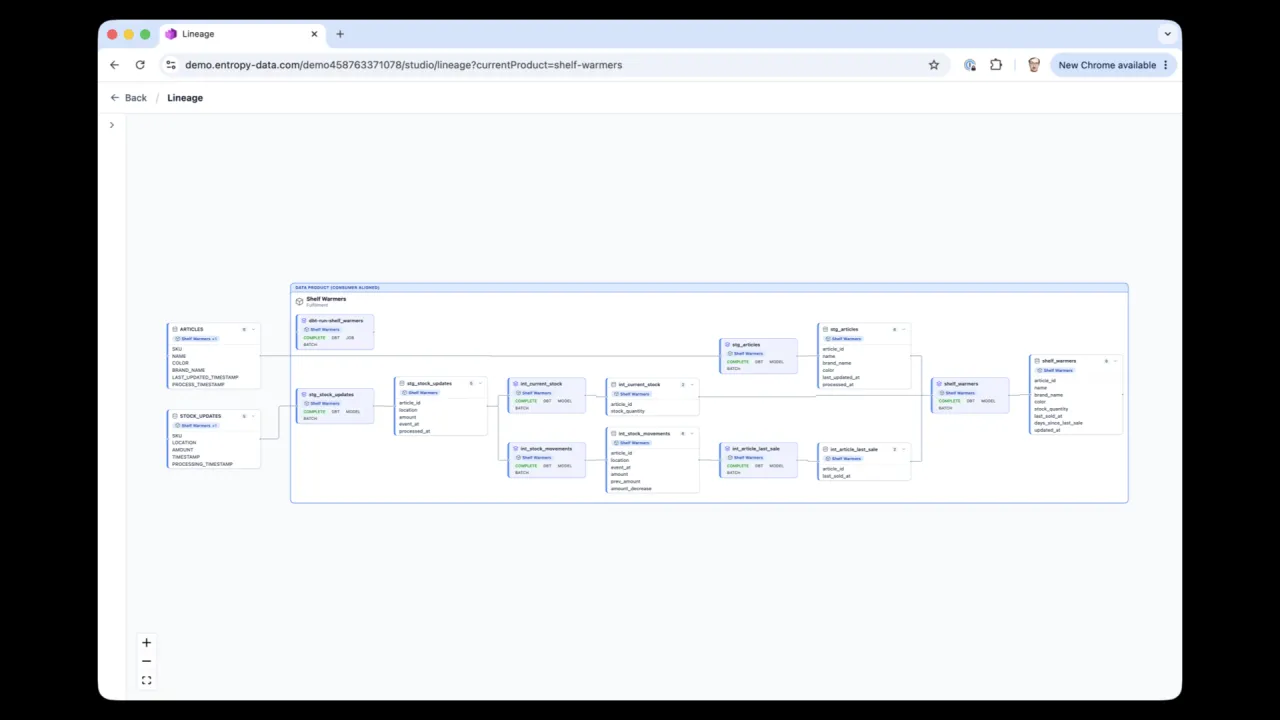
The pipeline had run, and the lineage is the proof. It shows each step down to the columns: the SKU comes from one table, the brand from a brand name, the unsold stock is computed from the stock updates, and the last sale date is taken from another. "That was all done in the background for us, based on the metadata, based on the data contract."
The last step was the data contract test. The agent finished with a checklist of everything it created, after 7 minutes and 20 seconds "and a lot of tokens".
Live Demo: Changing the Contract
A change starts with the contract as well. Simon creates a branch of the contract and edits it: instead of the individual SKUs, the table should have a count of SKUs as a number. He removes the SKU column, adds the count, and saves the branch.
Then the coding agent gets the same command as before: implement it. "In the coding agent it will always be the same command. We drive it all by changing the contract." That is why the contract matters so much: it is the specification for building data pipelines.

This Is the Way
"That's why the contract is so important. And to cite a very famous science fiction figure: this is the way."
The host summed it up as "mind-expanding", both for what the agents can do and for how fast a capability can be deployed with them.
Try It Yourself
Everything in the demo is available to try. Write contracts with the Data Contract Editor, test them with the Data Contract CLI, give your coding agent the skills from the dbt Data Product Builder, and explore the marketplace at demo.entropy-data.com. The POA Summit talk has screen recordings of the same kind of demo.
Simon also pointed to the Advent of Data Products, an advent calendar with one idea for better data products each day in December.
Reach Simon at simon.harrer@entropy-data.com or on LinkedIn.
Q&A
From the audience and the host after the talk.
Q: How well does ODCS support arrays, nested objects, and other non-relational structures?
ODCS was originally created for relational data, but it is set up to support arrays, objects, and nested structures, and that support has become really good over time. You can describe heavily nested JSON, or the arrays that are normal on BigQuery, and arrays are typed. The limit is that it still looks at data from a relational perspective. If an array may hold either one kind of object or another, it breaks, because it always assumes a union and cannot express an exclusive or. JSON Schema is more powerful there. ODCS deliberately trades that for being more SQL compatible and less oriented towards operational systems.
Q: How easy is it to take the data model of a SaaS platform like Salesforce as the starting point for a contract?
As long as the platform offers its data model through a REST API, that works. A contract assumes a relational model, but that model can be exposed through REST. Think of an API with one endpoint for customers and one for orders: they are still two tables, just exposed over REST, and you can still model and check a foreign key between them. The checking is less straightforward and can take a long time, because a REST API is not optimized for joining data, but conceptually it is not a problem. You can also use the contract on the Salesforce API as the starting point, and pump the data into a data lake. The same holds for JSON or CSV files on an SFTP server, or data in a Kafka topic: harder to use, but conceptually still tables with relationships that you can check.
Q: Do ontologies have to be written in YAML, or can you use other formats such as OWL? And do the semantic links point to shared definitions, for example in SKOS?
Other formats can be linked and imported. But Simon sees an interesting movement in the world of ontologies. The big vendors have jumped on the topic and push ontologies as a business data model: less about formally correct, machine-readable inference that derives new knowledge, more about AI-based analysis. Apache Ossie, with its ontology and semantic model standards, is one symptom, and all the big vendors push the same direction. "They're kind of redefining the word, but with so much money and power that, at least what I think, they will win. Please don't throw stones at the messenger." When you import an OWL ontology, you probably lose the inference capability, and whether that is needed in the future is open.
The host added that in high-hazard industries, a consistent meaning of fields as data moves between systems is critical, because misread data can cause accidents. Simon's view: meaning at the schema level, what this column is, is becoming extremely easy to carry across all your systems. Reasoning over the ontology, such as SKOS close matches and exact matches, is less certain, "a topic for a follow-on call".
Q: Are there dependencies between contracts, where a change in one has implications for others? How is that managed?
The demo showed a small dependency graph: a new data product relying on three others. Each contract focuses on its own interface, and you can evolve your own interface, but you have to manage the change process. "It's like an API. Everybody can change their own API, but they have to be aware of their consumers." Run an impact analysis, a blast radius analysis: how are your consumers affected, and their consumers in turn? For a breaking change, you are not allowed to just change the contract. You create a new data offering next to the old one, bring the consumers over, and phase out the first. That includes changes beyond the shape of the data: if a classification changes, for example because personal data enters the dataset, access rights may be affected too.
Q: Data moves through many products and pipelines, often beyond its originally planned usage. Can the terms of use be inherited, so that a contract stops propagation beyond what it allows?
That you would have to build yourself. A contract covers one specific interface. If the data travels on, the limitation has to travel with it: when you share it on unchanged, you also have to share the license agreement. It depends on what happens in between: if you anonymize the data, the limitation may no longer apply. The idea is to enforce this as a policy over all the metadata and check it, for example with AI. "It's not a lot of data, it's just a little bit of metadata, so it's easy to check and monitor."
Q: You are heavily involved in two standards at the Linux Foundation. How does that work, and what value have you seen from it?
Simon considers it crucial that open standards are driven by open institutions, not by one vendor declaring how it wants things done. At Bitol, the Linux Foundation project behind the standards, people from vendors, consultancies, and end users bring in their experience. "Of course, not always the very best solution wins. It's politics in the end." But it is neutral, and everybody fights for a great standard. Changes go through an RFC process: you propose it, the working group discusses it, and the Technical Steering Committee votes. It is unpaid work, but many people are grateful for it, and the adoption of ODCS is going up steeply. "I like the impact that I have on the world right now": open standards, supported by open-source tooling such as the Data Contract CLI.
Q: Where is the standard going over the next few years?
Bitol is a family of standards. The Open Data Contract Standard came first, then the Open Data Product Standard, and more will follow to build an ecosystem. Next up is a standard format for the results of checking a contract, so that many tools can work with test results in the same way. The other area moving at great speed is Apache Ossie, with its semantic models and ontologies. Simon sees the future in combining them, and using the result as input for AI agents to do the work for us.
Related articles
What Is a Data Contract?
The basics: what a data contract defines, who owns it, and how it is used to share data that consumers can trust.
Building a Data Product Contract-first (with AI)
The POA Summit 2026 talk on the same approach, with screen recordings of three live demos.
Data Product Builder: Build Data Products with your Coding Agent
Contract-driven development for data products: write or extend an ODCS data contract, then ask Claude Code, OpenAI Codex, or GitHub Copilot CLI to implement it.